Key Takeaways
- Learning how to write a college essay starts with reading the instructions and rubric carefully so you know what your professor expects.
- Narrow your topic enough to develop a clear argument or analysis within the required word count.
- Research before drafting and use credible academic sources to support your ideas rather than letting sources replace your own analysis.
- A strong college essay needs a focused thesis statement that gives the entire discussion a clear direction.
- Organize body paragraphs around distinct points, with each one connecting evidence back to your thesis.
- When writing a college essay, follow the required citation style, whether your course calls for APA, MLA, Chicago, or another format.
- Leave time to revise the content and structure before proofreading grammar, citations, formatting, and other submission requirements.
College essays get harder when you start writing before you are clear on what the professor actually wants. You may understand the topic and still lose marks because the argument is too broad, the evidence is weak, the structure does not follow the rubric, or the discussion describes sources instead of analyzing them.
Learning how to write a college essay means learning how to turn course instructions into a focused piece of academic writing. That involves understanding the prompt, narrowing the topic, researching credible sources, developing a clear thesis, and building paragraphs where evidence supports your own analysis. The exact approach can change with the subject and essay type, but the professor’s instructions and grading criteria should always guide your decisions.
If a deadline is close or you are struggling to turn the requirements into a complete essay, you can also get a professionally written college essay around your topic, academic level, formatting requirements, and deadline. Otherwise, the process in this guide will take you through writing a college essay yourself, from breaking down the instructions to proofreading the final version.
The best place to begin is not the introduction or thesis statement. Start with the instructions, because they determine what everything else in the essay needs to accomplish.

What Makes a College Essay Different From High School Writing?
At the college level, simply showing that you understand a topic is usually not enough. Professors expect you to do something with what you have learned: develop an argument, examine an issue, interpret evidence, compare positions, or reach a reasoned conclusion. That added depth is one of the biggest adjustments students face when learning how to write a college essay.
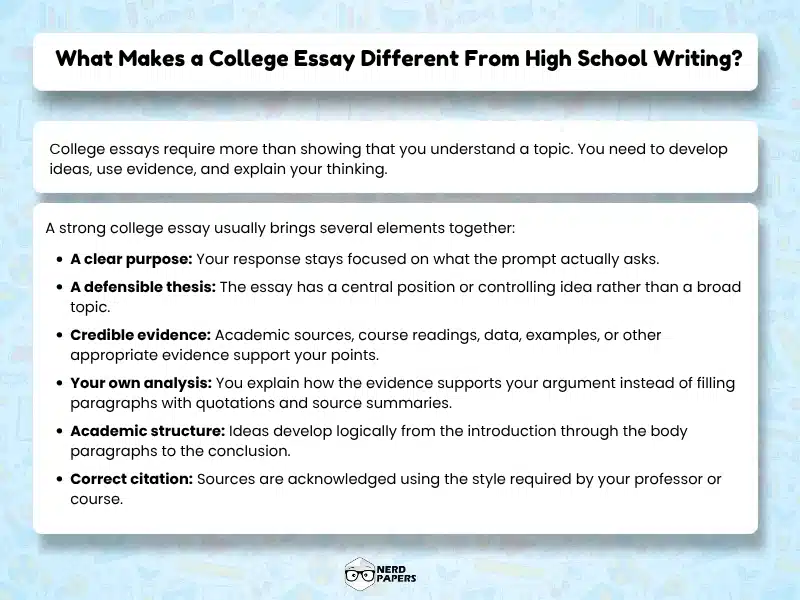
A strong college essay usually brings several elements together:
- A clear purpose: Your response stays focused on what the prompt actually asks.
- A defensible thesis: The essay has a central position or controlling idea rather than a broad topic.
- Credible evidence: Academic sources, course readings, data, examples, or other appropriate evidence support your points.
- Your own analysis: You explain how the evidence supports your argument instead of filling paragraphs with quotations and source summaries.
- Academic structure: Ideas develop logically from the introduction through the body paragraphs to the conclusion.
- Correct citation: Sources are acknowledged using the style required by your professor or course.
The level of analysis will vary by course. Writing a college essay for history may require interpreting primary and secondary sources, while a literature essay may center on close analysis of a text. A sociology essay could ask you to apply a theory to an issue, while another course may require you to compare competing arguments. The subject changes, but the underlying expectation remains: your ideas need to be developed and supported rather than simply stated.
That is why there is no single college essay template that works for every course. The subject, essay type, and professor’s expectations all influence how you should approach the work. Before you can decide what to argue or how to structure it, you first need to unpack those requirements and turn them into a clear writing plan.
How to Write a College Essay Step by Step
Once you understand what separates college-level writing from simpler essay work, the process becomes easier to manage. Writing a college essay is less about getting everything right in one draft and more about making the right decisions in the right order, starting with what your professor actually expects.
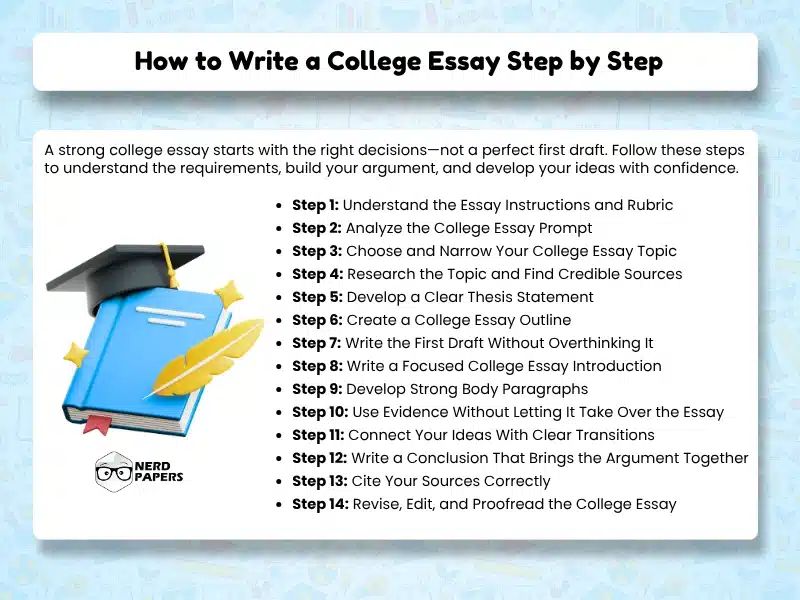
Step 1: Understand the Essay Instructions and Rubric
Before researching a topic or drafting a thesis, read the instructions closely. Your professor may specify the essay type, required length, number or type of sources, citation style, formatting, and particular questions that need to be addressed. Missing one of these requirements can weaken an otherwise well-written essay.
If you have a grading rubric, use it as more than a final checklist. Look at where the marks are concentrated. A rubric that gives significant weight to critical analysis, for example, is telling you that summarizing sources will not be enough. If evidence and research carry substantial marks, you know early on that unsupported claims will be a problem.
Before moving forward, you should be able to answer:
- What exactly am I being asked to discuss, analyze, compare, or argue?
- What evidence or sources am I expected to use?
- What are the word count, citation style, and formatting requirements?
- Which parts of the rubric carry the most weight?
This is a basic but often overlooked part of how to write a college essay. The instructions set the boundaries; the rubric shows where quality will be judged. Once those are clear, you can turn your attention to the prompt itself and work out exactly what question your essay needs to answer.
Step 2: Analyze the College Essay Prompt
Once the requirements are clear, focus on the prompt itself. A common mistake when writing a college essay is responding to the general topic instead of the specific task. If the prompt says evaluate, for example, explaining the topic is not enough. You need to make a judgment and support it with evidence.
Pay particular attention to the instruction words because they tell you what kind of thinking the professor expects:
- Analyze: Break the subject down and explain relationships, causes, patterns, or significance.
- Compare: Examine meaningful similarities and differences using clear points of comparison.
- Evaluate: Judge the strength, value, or effectiveness of something using relevant criteria and evidence.
- Discuss: Explore the issue in depth, usually by considering evidence, arguments, or different perspectives.
- Argue: Take a defensible position and build a case for it.
Then rewrite the prompt as a question you can answer. For instance, “Evaluate the impact of social media on political participation among college students” becomes: How significant is social media’s effect on college students’ political participation, and what evidence supports that judgment? That gives your research a purpose instead of sending you searching broadly for anything related to social media and politics.
Understanding this distinction is central to how to write a college essay that stays relevant from beginning to end. Once you know exactly what question you need to answer, the next decision is much easier: narrowing the topic until it is specific enough to explore properly within your word count.
Step 3: Choose and Narrow Your College Essay Topic
A broad topic gives you plenty to mention but very little room to say anything meaningful. If your topic is simply climate change, social media, or mental health in education, you could spend the entire essay providing background and never develop a focused argument. When learning how to write a college essay, narrowing the topic helps you move from general information to analysis.
Too broad:
Social media and education
More focused:
How social media affects classroom participation among first-year college students
Even more focused:
Whether course-based social media groups improve participation among first-year college students in online classes
How narrow you should go depends on the prompt and word count. A 1,000-word essay needs a tighter scope than a 3,000-word essay, but the topic still needs enough depth for research, evidence, and discussion. Before settling on it, ask whether you can explore the issue properly rather than simply describe it.
This is where writing a college essay starts to gain direction. A focused topic tells you what belongs in your research and, just as importantly, what does not. With those boundaries in place, you can begin looking for credible sources that will help you develop an informed answer rather than collecting information at random.
Step 4: Research the Topic and Find Credible Sources
Now that the topic has clear boundaries, research with a purpose. Do not collect sources simply because they mention your topic. Look for evidence that helps you answer the prompt, test your developing position, or understand where scholars disagree. This makes writing a college essay much easier later because your sources already have a role in the discussion.
For most college essays, useful research may include peer-reviewed journal articles, academic books, course readings, government publications, and reputable institutional sources. As you research, keep brief notes on:
- the main claim or finding of each source;
- evidence you may actually use;
- how the source connects to your developing argument;
- publication details needed for the required citation style.
Try not to build the essay around whichever sources you happen to find first. Good research may challenge your initial view, reveal a distinction you had missed, or show that your topic needs to be narrowed again. Part of understanding how to write a college essay is allowing credible evidence to shape your thinking rather than searching only for sources that confirm what you already believe.
Once the research gives you a clearer view of the issue, you are ready to turn that understanding into the central claim that will hold the essay together: your thesis statement.
Step 5: Develop a Clear Thesis Statement
After researching the topic, you should have enough evidence to decide what your essay will actually say. Your thesis statement turns that direction into a clear central claim. It should respond to the prompt and give the reader a sense of the position, interpretation, or main idea the rest of the essay will develop.
Compare these two examples:
Weak:
Social media affects college students in many ways.
Stronger:
Although social media can distract students during independent study, course-based online communities can improve participation by making peer discussion more accessible outside class.
The stronger version does more than announce the topic. It makes a claim that can be examined, supported, and developed across several body paragraphs. That is an important distinction in how to write a college essay at an academic level.
Your thesis does not have to be perfect on the first attempt. In fact, writing a college essay often changes how you understand the topic, so your original claim may need to become narrower or more precise as the discussion develops. What matters at this stage is having a defensible direction rather than a vague statement of subject.
With that direction established, the next task is deciding how each major point will contribute to it. A simple outline can help you see that structure before you commit to full paragraphs.
Step 6: Create a College Essay Outline
With your thesis in place, map out how you will prove or develop it. An outline does not need to contain complete sentences or every detail you plan to include. Its main job is to make sure each section has a clear purpose before writing a college essay in full.
A practical outline might look like this:
Introduction
- Establish the specific issue or context
- Lead into the central argument
- State the thesis
- First major point supporting the thesis
- Relevant evidence
- Your analysis of that evidence
- Next major point or development
- Supporting evidence
- Analysis and connection to the thesis
- Further argument, comparison, or counterpoint where appropriate
- Evidence
- Analysis
- Bring the main argument together
- Show what the discussion demonstrates
- End with the broader significance of the argument
The number and function of your body paragraphs will depend on the essay length and prompt, so do not treat this as a fixed template. For example, a compare-and-contrast essay may organize its discussion differently from an argumentative or analytical essay.
A useful test when learning how to write a college essay is to look at the outline without the evidence. Do the main points alone form a logical argument? If two sections repeat the same idea or one does not clearly contribute to the thesis, fix the structure now. It is much easier to move a few outline points than several finished paragraphs.
Once the sequence makes sense, you have enough direction to begin the first draft without having to decide where every idea belongs as you write.
Step 7: Write the First Draft Without Overthinking It
Your outline has already done the planning, so the first draft is where you turn those points into a connected argument. At this stage, focus on developing your ideas rather than stopping every few sentences to perfect the wording. Constant editing can interrupt the logic you are trying to build.
When writing a college essay draft, keep the thesis visible and use it as a filter. Each paragraph should contribute something different to the central argument, and the evidence you include should have a clear reason for being there. If you discover a stronger point while drafting, adjust the outline rather than forcing the essay to follow a plan that no longer works.
Do not worry if the first version is slightly over the word count or some transitions still feel rough. Those are revision problems. The immediate goal is to get a complete argument onto the page so you can see what actually works.
This is a practical part of learning how to write a college essay: your first draft gives you something concrete to improve. Once the main argument exists, you can return to the beginning and make sure the introduction sets it up clearly.
Step 8: Write a Focused College Essay Introduction
Once the first draft exists, return to the introduction and make sure it leads directly into the argument you actually developed. A college essay introduction does not need a dramatic hook. Its job is to give the reader enough context to understand the issue, establish the direction of the discussion, and lead naturally to your thesis.
A useful introduction generally moves through three functions:
For example, if your essay evaluates social media use in college learning, you do not need to begin with the history of social media or a broad claim about technology changing the world. Start close to the issue your essay examines, establish the specific academic context, and then introduce the argument you will develop.
When learning how to write a college essay, it is important to keep the introduction proportional to the rest of the discussion. Too much background delays your argument and leaves less room for analysis. When writing a college essay, include only the context the reader genuinely needs to follow what comes next.
A focused introduction tells the reader where the essay is going. The body paragraphs now have to deliver on that promise by developing the thesis one point at a time.
Step 9: Develop Strong Body Paragraphs
Body paragraphs are where your thesis is actually tested and developed. Each paragraph should focus on one clear point rather than trying to cover several ideas at once. When writing a college essay, a useful question to ask is: What does this paragraph contribute to my overall argument? If the answer is unclear, the paragraph probably needs a stronger focus.
A solid body paragraph usually needs four things:
- A clear point that connects to the thesis
- Relevant evidence from a credible source
- Analysis explaining what that evidence shows
- A connection back to the wider argument
The analysis is where college-level writing often succeeds or falls short. For example, adding a quotation and then moving straight to the next source leaves the reader to interpret its significance. Instead, explain why the evidence matters, what it demonstrates, and how it supports or complicates your claim.
Understanding this relationship between claim, evidence, and analysis is central to how to write a college essay with real academic depth. Once your paragraphs have clear points, the next step is making sure the evidence inside them supports your argument without taking over your own analysis.
Step 10: Use Evidence Without Letting It Take Over the Essay
Finding a strong source is only half the job. You still need to show the reader why that evidence matters. A college essay can contain plenty of research and still feel weak if most of the discussion consists of quotations, statistics, or summaries with little interpretation from the writer.
When writing a college essay, think of evidence as something you work with rather than something you simply insert. After presenting a source, ask:
- What does this evidence actually show?
- How does it support, challenge, or qualify my point?
- Why is it relevant to the argument I am making?
For instance, if a study finds that students who participate in online course discussions report higher engagement, repeating that finding only tells the reader what the researchers discovered. Your analysis should explain how the finding relates to your argument, whether there are limitations to consider, and what conclusion can reasonably be drawn from it.
This distinction is essential to how to write a college essay with academic depth. Your sources provide evidence and scholarly context, but the essay should still be driven by your reasoning. Once that balance is working within individual paragraphs, the next concern is making sure those paragraphs connect to one another instead of reading like separate pieces of analysis.
Step 11: Connect Your Ideas With Clear Transitions
Strong paragraphs can still feel disconnected if the reader cannot see how one point leads to the next. Transitions are not just words like however, therefore, or in addition. At college level, they should show the relationship between ideas and help the argument develop logically.
For example, imagine one paragraph discusses the benefits of online learning and the next examines its limitations. Instead of starting the second paragraph with “However, online learning also has disadvantages,” connect it directly to the previous point:
While greater flexibility can improve access to learning, that advantage depends heavily on a student’s ability to manage time and work independently.
The transition does more than announce a contrast. It uses the previous idea to introduce the next one.
When writing a college essay, look at the first and last sentences of neighboring paragraphs. If the shift feels sudden, clarify whether the next point extends, contrasts with, qualifies, or builds on what came before. This is another important part of how to write a college essay that reads as one developing argument rather than a collection of separate points.
Once the body flows logically from one idea to the next, you can bring those ideas together in a conclusion that shows what the discussion has ultimately established.
Step 12: Write a Conclusion That Brings the Argument Together
Your conclusion should show what the essay has established, not simply repeat the introduction in different words. By this point, the reader has seen your evidence and analysis, so use the final paragraph to bring those ideas together and reinforce the significance of your argument.
When writing a college essay conclusion, avoid introducing a completely new claim or source. Instead, move from your main finding toward what it means. For example, if your essay has examined whether online learning improves accessibility, the conclusion could acknowledge the benefits identified in your analysis while explaining the conditions under which those benefits are most likely to occur.
A useful final check is to ask: What can I say now that I could not fully justify before presenting the evidence? That question helps you write a conclusion based on the discussion you actually developed.
Knowing how to write a college essay also means knowing when to stop. Once the argument has reached a clear, supported conclusion, do not stretch the final paragraph with broad statements just to make it sound important. Bring the discussion to a purposeful close, then turn your attention to making sure every source used along the way is cited correctly.
Step 13: Cite Your Sources Correctly
Using credible evidence is only useful if the reader can tell where it came from. Every quotation, paraphrased idea, statistic, or finding taken from another source needs to be acknowledged according to the citation style required for your course.
When writing a college essay, check the instructions before formatting citations. Your professor may require APA, MLA, Chicago, or another style, and each handles in-text citations, references, and source details differently. Do not switch between styles simply because different sources display their information differently.
Citation also needs to work naturally with your writing. Instead of dropping a quotation into a paragraph and expecting it to speak for itself, introduce the evidence, cite it, and then explain its relevance to your argument. This keeps the source connected to your own analysis rather than making the paragraph feel assembled from outside material.
Correct citation is part of how to write a college essay responsibly, but formatting should not be the only thing you check. With the argument, evidence, and citations now in place, the final step is to review the essay as a whole and fix anything that weakens its clarity, logic, or presentation.
Step 14: Revise, Edit, and Proofread the College Essay
A finished draft is not a finished essay. Before submitting, read it first for the quality of the argument, then for the quality of the writing. Trying to fix everything at once makes it easy to spend time correcting sentences while missing a weak paragraph or an unsupported claim.
For a more useful final review, work in this order:
- Argument: Does the essay answer the prompt, and does every major point contribute to the thesis?
- Evidence and analysis: Are your claims supported, and have you explained the significance of the evidence instead of merely presenting it?
- Structure: Do the paragraphs follow a logical sequence with clear connections between ideas?
- Clarity: Cut repetition, vague wording, unnecessary background, and sentences that make a simple point harder to understand.
- Final checks: Proofread grammar and punctuation, verify citations, confirm the word count, and compare the finished essay with the rubric and submission requirements.
Revision is a major part of writing a college essay because your argument often becomes clearer only after you can see it in full. You may find that the thesis needs tightening, two paragraphs make essentially the same point, or a section needs more analysis to justify its claim. These are more important fixes than correcting surface-level errors too early.
The final proofread comes last. When learning how to write a college essay, that distinction matters: revision improves what you are saying, while editing and proofreading improve how clearly and accurately you say it. Once both are complete, your essay should not only read well but also meet the academic expectations you identified at the very beginning.
With the writing process complete, the next question is whether the finished essay meets the standard expected at college level. Looking at it from a professor’s perspective can reveal the difference between an essay that simply follows the requirements and one that demonstrates stronger academic thinking.
What Professors Actually Look for in a Strong College Essay
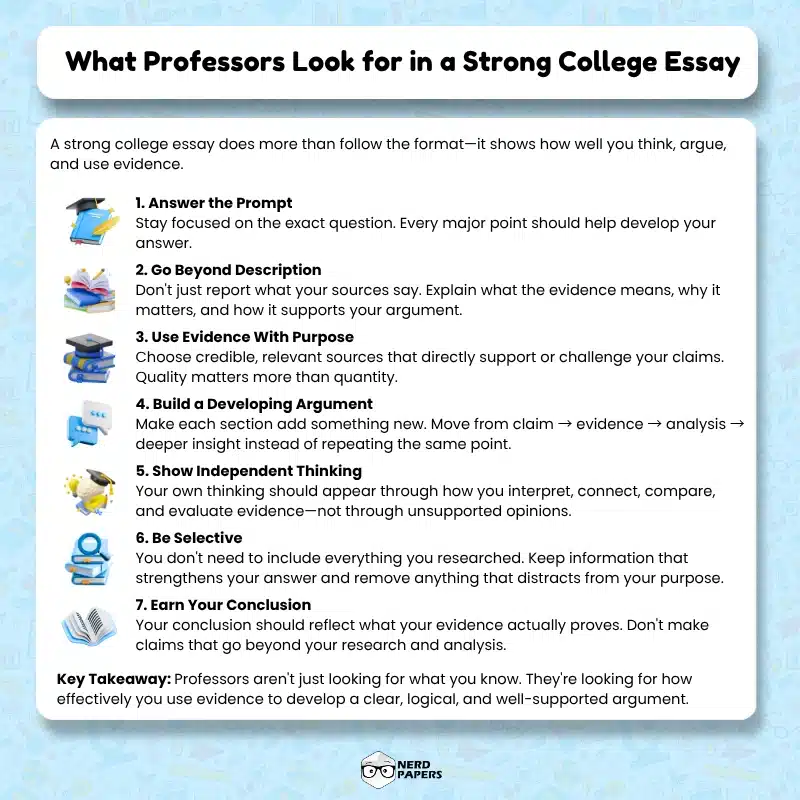
Following the correct structure and citation style does not automatically make an essay strong. Professors also look at how well you answer the question, develop your reasoning, use evidence, and make decisions about what deserves space. Understanding these expectations gives you a better way to judge your work after writing a college essay.
A Clear Answer to the Actual Question
A well-researched essay can still lose focus if it gradually shifts from answering the prompt to discussing everything related to the topic. Professors want to see that you understand the specific task and can keep your argument centered on it.
This matters throughout the essay, not just in the thesis. Each major point should help answer the question in some way. If a paragraph contains interesting information but does not move that answer forward, its relevance is questionable.
Analysis That Goes Beyond Description
One of the clearest differences between basic and stronger college-level writing is what you do with information after presenting it.
Description asks: What does the source say?
Analysis asks: What does it mean, why does it matter, and what does it contribute to my argument?
If you are learning how to write a college essay at a stronger academic level, this distinction matters. Professors generally do not want paragraphs filled with facts and source summaries. Depending on the task, they may expect you to interpret evidence, compare viewpoints, evaluate claims, identify relationships, or explain the significance of what you have found.
Evidence That Has a Clear Job
More sources do not automatically produce a better essay. What matters is whether the evidence is credible, relevant, and strong enough to support the claim you are making.
For each important piece of evidence, consider:
- Does it directly support or complicate my point?
- Is this source appropriate for the subject and claim?
- Am I relying too heavily on one source or viewpoint?
- Have I ignored evidence that challenges my position?
This is where source selection becomes part of academic judgment. Ten loosely relevant references may contribute less than five well-chosen sources that are properly analyzed.
An Argument That Develops Instead of Repeating Itself
A strong essay should go somewhere. If three body paragraphs make essentially the same point with different examples, the discussion may be supported but it has not developed very far.
Instead, let each section add something:
Not every essay will follow that exact sequence, but the principle is useful. As the discussion progresses, the reader should understand the issue more deeply than they did after the first body paragraph.
Independent Thinking Without Unsupported Opinions
Independent thinking does not mean replacing academic evidence with personal opinion. It appears in how you interpret, connect, question, and evaluate the evidence you have gathered.
Unsupported opinion:
Social media is harmful to students because it causes distractions.
Reasoned academic claim:
Although social media can support communication between students, its academic value may depend on whether that interaction outweighs the attention problems associated with frequent use.
The second version gives you something to investigate rather than presenting an assumption as fact. That balance between evidence and your own reasoning is an important part of writing a college essay at university level.
Control Over What You Include
Good academic writing also shows restraint. You are not expected to include everything you learned during your research. You are expected to decide which information helps answer the question and develop it properly within the available word count.
That means cutting interesting background, examples, or sources when they pull the discussion away from its purpose. Knowing how to write a college essay includes knowing what the essay does not need.
A Conclusion the Essay Has Actually Earned
Finally, the strength of your conclusion should match the strength of your evidence. If your research shows a limited relationship between two factors, the conclusion should not suddenly claim that one definitively causes the other.
A useful question is: Could I justify this conclusion using only the evidence and analysis already presented in the essay? If not, the final claim may be reaching further than the discussion allows.
These qualities separate an essay that merely meets the basic requirements from one that demonstrates stronger academic thinking. They also make the weaknesses in a draft easier to recognize, which brings us to the mistakes that commonly cost college students marks.
Common College Essay Mistakes to Avoid
Even when you understand how to write a college essay, small weaknesses can pull down an otherwise solid piece of work. Most are not dramatic mistakes. They come from losing focus, relying too heavily on sources, or overlooking what the rubric actually rewards.
| Common Mistake | Why It Causes Problems | What to Do Instead |
| Answering the topic instead of the prompt | The essay may contain relevant information without completing the actual task | Keep returning to the specific question and instruction words |
| Using a thesis that is too broad | The argument becomes difficult to develop within the word count | Narrow the claim until you can support it properly |
| Summarizing sources instead of analyzing them | It shows research but little critical thinking | Explain what the evidence means and how it affects your argument |
| Adding quotations without explanation | The reader is left to make the connection | Introduce, cite, and analyze every quotation you use |
| Making unsupported claims | Assertions sound like opinion rather than academic reasoning | Match important claims with appropriate evidence |
| Using weak or irrelevant sources | Poor evidence weakens the argument built on it | Prioritize credible sources that directly relate to your question |
| Repeating the same point | Paragraphs add length without developing the discussion | Give each section a distinct role in moving the argument forward |
| Ignoring counterarguments | The discussion can appear one-sided | Address relevant competing evidence or interpretations where the topic requires it |
| Writing an oversized introduction | Too much background reduces the space available for analysis | Include only the context needed to understand the argument |
| Treating citation as a final task | Missing source details can create problems during final editing | Record citation information while researching and drafting |
| Using an unnecessarily complicated academic tone | Dense wording can hide otherwise clear ideas | Prefer precise, direct language over sentences written to sound sophisticated |
| Proofreading without checking the rubric | The essay may be polished but still miss a major requirement | Compare the final version against the instructions and grading criteria |
When writing a college essay, one of the most useful final checks is to separate content problems from presentation problems. A grammatical error needs editing, but an unsupported paragraph needs more evidence or analysis. A citation error needs correction, but a paragraph that does not answer the prompt may need to be removed entirely. Fixing the right type of problem first saves time and usually leads to a stronger final version.
Avoiding these mistakes gets the essay into much better shape, but before submission, it helps to run one final check across the prompt, argument, evidence, structure, citations, and formatting.
College Essay Writing Checklist
Before submitting, step away from the essay for a while if your deadline allows, then read it again with the original instructions beside you. At this stage, writing a college essay is less about adding new material and more about confirming that the argument, evidence, academic requirements, and presentation all work together.
Prompt and Argument
- I answered the specific question rather than only discussing the general topic.
- My thesis gives the essay a clear and defensible direction.
- Every major point contributes to the thesis.
- My argument develops as the essay progresses instead of repeating the same idea.
Research and Analysis
- My important claims are supported by credible and relevant sources.
- I explain evidence instead of leaving quotations, statistics, or findings to speak for themselves.
- My own analysis remains visible throughout the discussion.
- I have considered relevant opposing evidence or interpretations where necessary.
Structure and Clarity
- The introduction provides only the context needed to understand the argument.
- Each body paragraph has a clear purpose.
- Ideas move logically from one paragraph to the next.
- The conclusion follows from the evidence and analysis already presented.
- I removed repetition, unnecessary background, and vague wording.
Citations and Submission Requirements
- Every borrowed idea, quotation, statistic, or finding is properly acknowledged.
- My in-text citations and reference list follow the required citation style.
- I am within the required word count.
- Formatting follows my professor’s instructions.
- I checked the finished essay against the grading rubric.
- I completed a final grammar, spelling, and punctuation check.
A checklist cannot tell you whether an argument is genuinely strong, but it can catch the requirements that are easy to overlook after several revisions. One final question brings the whole process of how to write a college essay together: Does this essay clearly answer what I was asked, and have I given the reader enough evidence and reasoning to accept that answer?

Final Thoughts on How to Write a College Essay
Learning how to write a college essay is not about following one perfect template. College courses, professors, and essay types come with different expectations, so the strongest approach is to let the prompt and rubric guide the decisions you make from the beginning.
Good college essay writing comes down to having a clear purpose for every part of the essay. Your thesis gives the discussion direction, your sources provide credible evidence, and your analysis shows how that evidence supports the argument you are making. Structure, transitions, citations, and academic tone should help communicate those ideas clearly rather than make the essay unnecessarily complicated.
As you become more comfortable writing a college essay, the process also becomes less about filling a required word count and more about making deliberate choices about what deserves space. Read the instructions carefully, research with a purpose, develop your reasoning, and leave enough time to revise what you have written.
That is ultimately how to write a college essay at a stronger academic level: answer the question you were given, support your answer with credible evidence, and make your own reasoning clear from the introduction through the conclusion.
Frequently Asked Questions About Writing a College Essay
How do you write a college essay?
Start by reading the prompt and rubric so you know exactly what your professor expects. Then narrow the topic, research credible sources, develop a clear thesis, and organize your main points before drafting. A major part of how to write a college essay is connecting evidence to your own analysis rather than simply summarizing what your sources say. Once the draft is complete, revise the argument and structure before proofreading and checking the submission requirements.
What should a college essay include?
Most college essays need a focused introduction, a clear thesis or central argument, well-developed body paragraphs, relevant evidence, analysis, and a conclusion supported by the discussion. The exact requirements depend on the essay type and course. When writing a college essay, always follow your professor’s instructions rather than assuming one structure will work for every task.
How do you start a college essay?
Start by understanding the question before worrying about the opening sentence. Once you know your argument, give the reader enough context to understand the issue and gradually narrow the introduction toward your thesis. Learning how to write a college essay also means avoiding introductions filled with broad background that never contributes to the discussion.
How long should a college essay be?
There is no universal word count for a college essay. The required length depends on the course, professor, essay type, and complexity of the topic. Follow the stated word count and use that limit to control the scope of your argument. When writing a college essay, a narrower argument developed properly is usually more effective than trying to squeeze a very broad topic into limited space.
How many paragraphs should a college essay have?
There is no fixed number. The familiar five-paragraph structure may work for some shorter essays, but it should not be treated as a rule for college-level writing. Use as many body paragraphs as necessary to develop the argument within the required word count. Each paragraph should have a distinct purpose and contribute something new to the thesis.
What sources should I use for a college essay?
Use sources appropriate to your course, topic, and professor’s requirements. These may include peer-reviewed journal articles, academic books, course readings, government publications, and reputable institutional sources. Knowing how to write a college essay includes judging whether a source is credible and relevant, not simply finding information that agrees with your position.
How do I make my college essay more analytical?
Move beyond explaining what a source says and examine why it matters to your argument. Compare evidence, identify relationships, question assumptions, evaluate competing interpretations, and explain the significance of your findings. Strong analysis is especially important when writing a college essay because professors usually want to see your reasoning alongside your research.
How do I know if my college essay is ready to submit?
Read the finished essay against the original prompt and rubric. Check that the thesis answers the question, each body paragraph contributes to the argument, claims have appropriate evidence, and the conclusion follows from your analysis. Then verify citations, word count, formatting, grammar, and proofreading. A final review against the actual grading criteria is one of the most reliable checks when learning how to write a college essay well.