Key Takeaways
- Learning how to write a personal statement starts with knowing what the university or college is asking for. Check the prompt, course requirements, and word or character limit before planning your content.
- A strong personal statement connects three things: why the subject interests you, what has prepared you to study it, and where you want that academic interest to take you next.
- Choose experiences because they are relevant, not simply because they sound impressive. Academic projects, independent reading, extracurricular activities, volunteering, or other experiences are useful when they reveal something meaningful about your preparation or development.
- When writing a personal statement, go beyond saying what you did. Explain what you learned, how the experience shaped you, and why it matters to the course or field you want to study.
- Give each part of your statement a clear purpose. Your ideas should build naturally from academic motivation and preparation to evidence, reflection, and future direction.
- Treat revision as part of the writing process. Check whether every paragraph adds value, remove vague or repeated points, strengthen weak connections, and proofread the final statement against the application requirements.
Knowing how to write a personal statement is not about finding impressive words or squeezing every achievement into one page. Your statement needs to show why you want to study a particular subject, what has prepared you for it, and how your experiences have shaped the academic direction you want to take at college or university.
The challenge is turning those experiences, interests, and goals into one focused application rather than a list of disconnected points. If you want the statement developed specifically around your academic background, chosen course, relevant experiences, and application requirements, a personal statement writing service provides a custom route from your information and instructions to a complete admissions statement.
When writing a personal statement, think beyond what you have done. Admissions readers also need to understand what you learned, why those experiences matter, and how they connect to the subject you want to study. This guide takes you through that process from checking the application requirements and selecting your strongest material to drafting, reflecting, revising, and completing the final statement.

How to Write a Personal Statement Step by Step
Once you know what your statement needs to communicate, the next task is turning your ideas into a clear application. The process below takes you from the application requirements to a finished draft without trying to write everything at once.
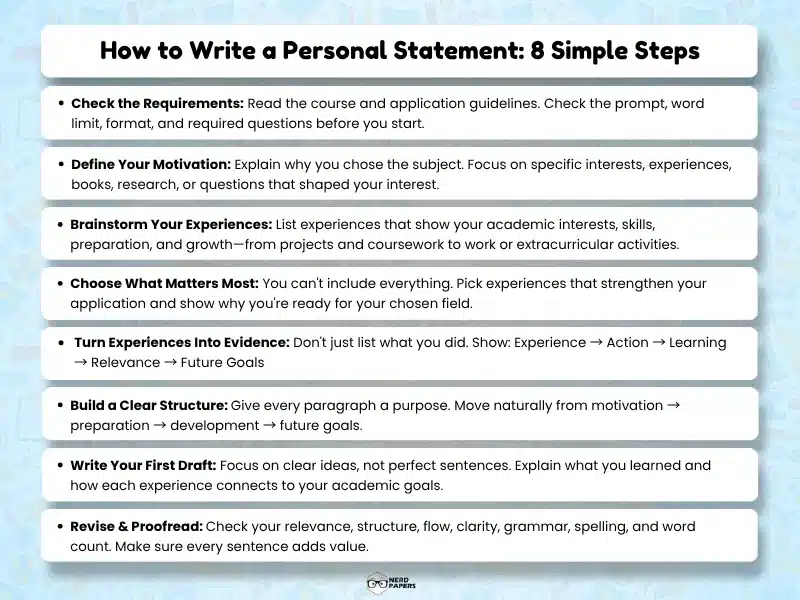
Step 1: Check the Application Requirements
Before writing a personal statement, read the instructions for the course, university, and application system you are using. Requirements can differ, so check the prompt, word or character limit, submission format, and any specific questions you are expected to address.
Pay particular attention to what the course expects from applicants. Entry requirements, admissions criteria, and course information can help you identify which academic interests, experiences, and qualities are most relevant. Use these requirements to guide your decisions rather than trying to fit a generic statement into every application.
Step 2: Define Why You Want to Study the Subject
A clear academic motivation gives your statement direction. Think about what draws you to the subject, which areas interest you most, and how that interest has developed through your studies or experiences.
Go further than saying you are “passionate” about the subject. Consider what you have read, studied, researched, questioned, or experienced that made you want to explore it further. This gives you specific material to work with and makes your motivation easier to demonstrate.
Step 3: Brainstorm Relevant Experiences
Before deciding what belongs in the final statement, make a broad list of experiences that could reveal something useful about you as an applicant. These might include coursework, academic projects, independent reading, research, competitions, extracurricular activities, volunteering, leadership roles, personal projects, or work experience that is relevant to your intended field of study.
At this stage, do not worry about turning each point into polished prose. The purpose is to identify material that could demonstrate your academic interests, preparation, skills, intellectual curiosity, or personal development.
Step 4: Choose the Experiences That Add the Most Value
You will rarely have enough space to include everything. Instead, choose experiences that strengthen the case you are making for yourself as a prospective student.
Ask what each experience reveals. Does it show deeper subject knowledge? Did it develop a relevant skill? Did it change how you think about the field? Did it prepare you for further study? A specific experience that answers one of these questions is usually more useful than several achievements mentioned without explanation.
Step 5: Decide What Each Experience Proves
Knowing how to write a personal statement also means knowing how to turn an experience into evidence. A useful way to do that is:
Experience → Action → Learning → Relevance → Future Direction
Identify what you experienced, what you personally did, and what you learned from it. Then connect that learning to your chosen subject and, where relevant, explain how it influenced what you want to explore next.
This prevents the statement from becoming a record of activities. Instead, each experience contributes something to the admissions reader’s understanding of your development and academic direction.
Step 6: Organize Your Ideas Before Drafting
Once you have selected your strongest material, decide how the ideas relate to one another. A natural progression might move from your academic motivation into evidence of your preparation and development before looking ahead to what you want to pursue at university.
Do not force every personal statement into the same number of paragraphs. Give each paragraph a clear purpose and arrange your ideas so that one develops naturally from the last.
Step 7: Write the First Draft
Now turn the plan into complete paragraphs. Concentrate first on explaining your ideas clearly rather than trying to perfect every sentence as you write it.
Make sure the draft does more than report events. Explain why important experiences mattered, what they taught you, and how they relate to your academic direction. You can refine the wording once the substance is in place.
Step 8: Revise, Edit, and Proofread
After completing the draft, review it at several levels. First, check whether every point is relevant and whether your academic motivation comes through clearly. Then look at the organization, transitions, repetition, specificity, and overall flow.
Finally, edit individual sentences and proofread for grammar, spelling, punctuation, formatting, and accuracy. Check the finished statement against the original application instructions as well. The goal is not simply to make the writing cleaner, but to make sure every part contributes something useful to your application.
What Should You Include in a Personal Statement?
When writing a personal statement, every detail should earn its place. Admissions teams already have other parts of your application, so the statement should add context they cannot get from grades or a list of activities alone. Focus on the interests, experiences, and development that show why you are prepared for the subject you want to study.
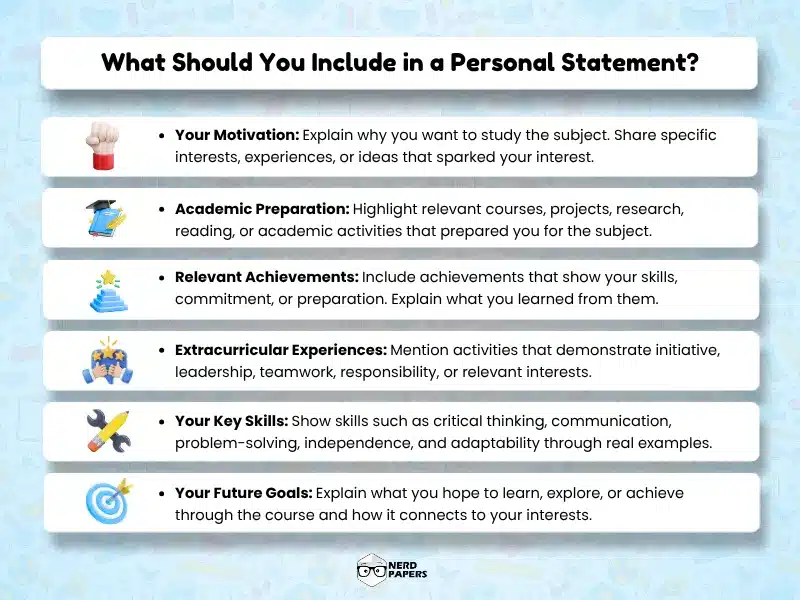
Your Motivation for Studying the Subject
Explain what genuinely interests you about the subject and how that interest developed. Instead of simply saying you have always wanted to study it, identify the ideas, questions, topics, or experiences that made you want to explore the field further.
Your motivation becomes more convincing when it is grounded in something specific. A topic you encountered in class, a book that challenged your thinking, a project you pursued further, or an issue you became curious about can reveal far more than a broad claim about being passionate.
Academic Experiences and Preparation
Use relevant academic experiences to show how you have already engaged with the subject. Depending on your background, this could include coursework, research, independent reading, academic projects, competitions, or subject-related activities.
Do not simply name what you studied or completed. Select details that reveal intellectual curiosity, subject knowledge, independent learning, or skills that have prepared you for further study. The important question is not only what did you do?, but what did it add to your understanding or development?
Relevant Achievements
An achievement belongs in your personal statement when its significance goes beyond the achievement itself. Explain what it required from you, what you gained from the experience, or how it connects to your academic interests.
This keeps achievements from becoming a second résumé. One relevant accomplishment that reveals something meaningful about your preparation can contribute more than several awards or results listed without context.
Extracurricular and Personal Experiences
Activities outside the classroom can add another dimension to your application when they reveal qualities or experiences relevant to university study. Volunteering, clubs, societies, leadership responsibilities, personal projects, community activities, and relevant hobbies may demonstrate initiative, independence, collaboration, responsibility, or sustained interest.
Be selective. You do not need to mention every activity you have participated in. Include the ones that help the reader understand something important about your development or readiness for the academic path you are pursuing.
Skills and Personal Qualities
Qualities such as critical thinking, communication, independence, resilience, leadership, adaptability, and problem solving can strengthen a university personal statement, but they should not appear as a list of positive adjectives.
While writing a personal statement, look for experiences that allow those qualities to become visible through what you actually did. Evidence makes a claim more credible and gives the admissions reader a clearer picture of how you approach learning, responsibilities, and challenges.
Your Future Academic Direction
Your statement should also give some sense of where your current interests are leading. You might discuss areas of the subject you want to explore further, knowledge you want to develop, or academic goals you hope to pursue through the course.
You do not need to have your entire future mapped out. What matters is showing that your previous experiences, present interests, and decision to pursue further study connect in a way that makes sense. Once you have identified this material, the next decision is which experiences are strong enough to carry that story.
Choosing Experiences That Strengthen Your Application
Once you know what could go into your statement, you need to decide what actually deserves the space. This is where many students go wrong. They try to include everything they have done instead of choosing the experiences that say the most about their academic interests, preparation, and development.
Prioritize Relevance Over Quantity
An experience does not need to be extraordinary to be valuable. What matters is whether you can connect it meaningfully to the course or field you want to study.
For each experience, ask what it adds to your application. A research project might show how your interest in a topic deepened. Independent reading could reveal intellectual curiosity. Volunteering might demonstrate responsibility or expose you to an issue connected to your field. If you cannot explain why an experience matters, including it simply takes space away from something more useful.
This is especially important when learning how to write a personal statement within a limited word or character count. Two experiences explored with genuine reflection will usually reveal more about you than six activities compressed into a list.
Balance Academic and Non-Academic Experiences
Your academic experiences provide evidence of your interest in and preparation for the subject. Relevant activities outside the classroom can add another layer by showing how you have developed qualities, interests, or perspectives that matter to your intended studies.
The two should work together rather than compete for space. If an extracurricular activity has little connection to your academic direction or development, you do not need to include it simply to appear well-rounded.
Include Work Experience Only When It Adds Academic Value
Work experience can belong in a college or university personal statement, but only when you can explain why it is relevant. A placement, internship, part-time role, or other experience may have introduced you to an aspect of your intended field, strengthened a transferable skill, or changed your understanding of what you want to study.
Keep the emphasis on what the experience contributes to your academic application. The job itself is not the focus. Its value comes from what you observed, learned, developed, or understood because of it.
Ask What You Learned, Not Just What You Did
A useful experience gives you something to reflect on. Instead of stopping at I completed this project or I took part in this activity, ask what changed because of it. Did it challenge an assumption? Develop a skill? Raise a new question? Deepen an existing interest? Influence what you wanted to study next?
The difference is often easier to understand when you can see how it works in a complete statement. These realistic personal statement examples for university applications show how different applicants present their experiences, academic interests, and goals within a finished statement, giving you a clearer reference for how individual points can work together without simply becoming a list of achievements.
Once you have chosen the experiences that genuinely add something to your application, the next task is arranging them so the statement develops as one connected piece rather than a series of separate points.
Building a Clear Personal Statement Structure
Once you have chosen your strongest material, structure determines how well those ideas work together. A good personal statement structure should take the reader through your academic interest, preparation, development, and future direction without making the statement feel like separate answers joined together.
Give Each Paragraph a Clear Purpose
Before drafting a paragraph, decide what you want the admissions reader to understand from it. One paragraph might develop your interest in the subject, while another could show how a project, academic experience, or relevant activity prepared you to study it further.
Avoid packing unrelated experiences into the same paragraph just because you want to mention them. When writing a personal statement, each paragraph should develop one main idea and use relevant evidence to give that idea substance.
Create a Simple Personal Statement Outline
A brief outline can help you see whether your ideas form a logical progression before you spend time polishing sentences. For each paragraph, map out:
Main point → Evidence → Reflection → Academic connection
For example, if a paragraph is about how your interest in a particular area developed, the evidence might be a research project or independent reading. Your reflection should then explain what you learned or began questioning and how that influenced your academic direction.
The outline does not need to prescribe an exact number of paragraphs. Its purpose is to make sure every major point has a reason for being there.
Arrange Ideas by Meaning, Not Just Chronology
A personal statement does not need to tell your life story from earliest to most recent. Chronological order can work in places, but it should not control the entire statement if a different order creates a stronger connection between your ideas.
Instead, group experiences according to what they demonstrate. An earlier classroom experience and a more recent independent project, for instance, may belong together if both show how your interest in the same subject area developed.
Understanding how to write a personal statement this way helps you build an academic narrative rather than a timeline of activities.
Build Logical Transitions Between Ideas
Good transitions do more than connect paragraphs with words such as furthermore or additionally. They show why one idea leads to the next.
You might move from an academic experience to the question it raised, then to the independent reading or project you pursued because of that question. This creates a visible line of development and helps the reader understand how your interests have grown.
With the overall structure in place, you can focus on the first paragraph and establish that academic direction from the beginning.
Starting Your Personal Statement Strongly
The opening should give the reader a clear sense of your academic direction without trying too hard to be memorable. You do not need a dramatic story or clever opening line. You need a relevant starting point that gives the rest of the statement somewhere meaningful to go.
Establish Your Academic Direction Early
A strong personal statement introduction should make your interest in the subject clear early enough that the reader understands what is driving your application. Rather than beginning with broad claims about how much you love a subject, narrow the focus to an idea, question, experience, or area of study that genuinely interests you.
This also gives you a natural route into the rest of the statement. Once your academic motivation is established, later paragraphs can show how you explored that interest and what has prepared you to take it further.
Begin With Something Specific and Relevant
If you are unsure how to start a personal statement, look at the experiences or ideas that shaped your interest in the subject. You might begin with an academic question you became interested in, an observation that changed your perspective, a topic you explored beyond the classroom, or an experience that pushed you to understand the field more deeply.
The important part is not how unusual the opening sounds. It is whether the opening reveals something meaningful about your academic interest and creates a logical connection to what follows.
Avoid Gimmicky Hooks and Generic Openings
When writing a personal statement, it can be tempting to make the first sentence sound impressive at any cost. That often leads to quotations, dictionary definitions, rhetorical questions, exaggerated childhood stories, or broad claims such as I have always been passionate about this subject.
These openings take up valuable space without necessarily telling the admissions reader anything useful about you. Specificity is usually more effective. Start with something that belongs to your own academic journey, then use the rest of the statement to show how that interest developed.
A clear opening establishes your direction, but the body has to give that direction credibility. That means turning the experiences you have chosen into evidence rather than simply describing what happened.
Turning Experiences Into Evidence in the Body
The body of your statement is where you show that your academic interest has substance. Rather than moving from one activity to the next, use your strongest experiences to reveal how you think, what you have learned, and how your interest in the subject has developed.
Move Beyond Describing What Happened
Description tells the admissions reader what you did. Reflection explains why it matters.
For example, mentioning that you completed an independent research project provides useful context, but the experience becomes more meaningful when you explain what you investigated, what challenged your thinking, or what you came to understand differently as a result.
This distinction is important when writing a personal statement because admissions readers are not simply looking for a record of activities. They need to see what those experiences reveal about your academic development and readiness for further study.
Turn Each Experience Into Meaningful Evidence
A useful way to develop an important experience is to think through five connected questions:
Experience → Action → Learning → Relevance → Future Direction
Start with the experience itself, then identify what you personally did rather than describing the activity in general. From there, explain what you learned and why that learning matters to the subject you want to study. Where it fits naturally, show how the experience influenced what you became interested in exploring next.
You do not need to force all five points into every paragraph. The framework is a way to think more deeply about your material so that each experience contributes something beyond description.
Show How Your Academic Interests Have Developed
Coursework, independent reading, research, academic projects, competitions, and other subject-related activities can show more than preparation. They can reveal how your thinking has changed over time.
If a book introduced you to an unfamiliar argument, for example, the useful point is not simply that you read it. What did the argument make you question? Did it lead you to another topic, source, or project? Did it change how you understood an issue you had already studied?
Learning how to write a personal statement at this level means showing that your interest is active. You are not only interested in the subject; you have already begun engaging with its ideas and following your curiosity further.
Give Non-Academic Experiences a Clear Reason to Be There
Volunteering, extracurricular activities, personal projects, and other experiences outside the classroom can strengthen the body when they reveal something relevant about your development. Their value comes from the connection you make, not from the activity alone.
A leadership role might demonstrate how you learned to manage responsibility or work with different perspectives. A personal project might show initiative and independent learning. Keep the explanation tied to what the experience adds to your application rather than allowing it to become a separate story.
Once your experiences are doing this work, your strengths become easier to demonstrate naturally. You no longer need to tell the admissions reader that you are independent, resilient, analytical, or responsible; the evidence can show it.
Showing Your Skills Without Simply Listing Them
Skills and personal qualities matter in a university application, but naming them does not prove that you have them. Admissions readers learn more from seeing how you handled a situation, approached a challenge, or took responsibility than from a sentence describing you as hardworking, resilient, or independent.
Replace Claims With Evidence
Instead of deciding which positive adjectives you want to use, look for moments where those qualities are already visible in your experiences.
If you want to demonstrate independence, you might discuss a project you took beyond the classroom or a topic you explored on your own. Critical thinking could emerge through the way you evaluated different arguments in a research task. Leadership may be evident in a situation where you organized people, made decisions, or took responsibility for an outcome.
When writing a personal statement, this approach makes your strengths more credible because the reader has evidence on which to judge them.
Choose Skills That Matter to Your Story
You do not need to demonstrate every quality associated with a strong university applicant. Choose the ones that genuinely emerge from your experiences and contribute to the academic picture you are building.
Depending on your course and background, these could include critical thinking, problem solving, communication, independence, initiative, collaboration, adaptability, resilience, or leadership. What matters is the connection between the quality, the experience that demonstrates it, and its relevance to your development.
Trying to fit too many strengths into the statement can have the opposite effect. It leaves little room to show where those qualities came from or why they matter.
Let the Evidence Speak for You
A useful test is to remove the label and see whether the experience still communicates the quality. If a paragraph clearly shows you taking initiative, you may not need to finish it by saying, This demonstrates that I am proactive.
This is an important part of learning how to write a personal statement with a natural voice. The reader should be able to understand your qualities from your decisions, actions, and reflections rather than being repeatedly told what to think about you.
Once your strengths are grounded in real experiences, the statement can focus on something equally important: making sure those experiences and reflections still sound distinctly like you.
Keeping Your Personal Statement Personal and Authentic
A personal statement should give admissions readers a sense of how you think, what matters to you academically, and how your experiences have shaped your direction. That individuality comes from the meaning you give to your experiences, not from trying to make your story sound unusual.
Write From Your Own Perspective
Two applicants may study the same subjects, complete similar projects, or take part in similar activities and still have very different things to say about them. One might become interested in a particular problem, while another may question an assumption or discover an area they want to explore further.
Focus on those individual responses when writing a personal statement. Explain what caught your attention, what made you think differently, and how an experience influenced your interests or decisions. These details reveal more about you than broad statements about being passionate or ambitious.
Replace Generic Language With Specific Meaning
Phrases such as I have always been passionate about this subject or this experience taught me many valuable skills leave important questions unanswered. What sparked that interest? Which skills did you develop? How did the experience change the way you approached your studies?
Replace broad claims with the details that make them true. If an academic project strengthened your interest in a field, explain what part of the project interested you and where that curiosity led. Specificity gives your statement substance without requiring exaggerated language.
Keep the Tone Confident, Reflective, and Natural
Understanding how to write a personal statement also means knowing how you should sound. Your tone should be appropriate for an academic application, but that does not mean making every sentence formal or complicated.
Use clear language that allows your ideas to carry the weight. Avoid inflated vocabulary, excessive adjectives, slang, and sentences written mainly to sound impressive. A confident statement explains experiences and ambitions precisely without overstating them.
Do Not Try to Sound Like Someone Else
Reading other statements can help you understand how an application may be developed, but copying another applicant’s wording, experiences, or style works against the purpose of personal writing.
Your strongest material comes from your own academic interests, decisions, experiences, and reflections. Keep those at the center of the statement, and the individual voice will follow naturally.
By this point, the reader should understand where your academic interest came from and how you have prepared to pursue it. The ending needs to carry that development forward rather than simply repeat what you have already said.
Ending With Clear Academic Direction
Your final paragraph should show where the interests and experiences discussed throughout your statement are leading. Rather than summarizing everything you have already said, use the ending to reinforce your readiness for further study and the academic direction you want to pursue.
Bring Your Academic Direction Into Focus
By the conclusion, the reader should already understand your motivation and preparation. You do not need to repeat your projects, achievements, or extracurricular activities. Instead, bring the main thread of the statement into focus by showing what those experiences have prepared you to do next.
For instance, if your statement shows a growing interest in a particular area of your subject, the ending can look ahead to developing that interest through more advanced study. This creates continuity between what you have already explored and what you now want from your university education.
Look Ahead to What You Want to Develop
When writing a personal statement, it is useful to think of the conclusion as a point of direction rather than a summary. Consider what you want to understand more deeply, which academic interests you hope to develop, or how university study will allow you to build on your existing preparation.
You do not need to present a fixed career plan unless it is genuinely relevant to your application. A clear academic goal is enough. The aim is to show that applying for the course is a considered next step rather than an isolated decision.
Avoid Repeating Your Introduction
A weak conclusion often returns to the same claim made at the beginning: I am passionate about this subject and look forward to studying it at university. That tells the reader very little after an entire statement has been devoted to demonstrating your interest.
A stronger ending reflects the development that has taken place across the statement. If you are learning how to write a personal statement effectively, ask one final question before finishing: Where have the experiences and ideas I discussed led me academically?
Answering that question gives the statement a sense of progression and leaves the reader with a clearer understanding of what you are ready to pursue next.
With the full draft now in place, the next stage is to test whether every part of it is relevant, clear, and necessary before submission.
Revising Your Personal Statement Before Submission
Finishing the first draft does not mean the statement is finished. Revision is where you find weak explanations, unnecessary details, awkward connections, and repeated ideas that were difficult to notice while drafting. Review the statement in separate passes rather than trying to fix everything at once.
First Review the Content
Start by reading for meaning, not grammar. Ask whether the statement gives the admissions reader a clear understanding of your academic motivation, preparation, and development.
Look closely at each experience you included. Have you explained why it matters, or have you only described what happened? Remove details that do not contribute to your application and develop points that need more reflection or context.
When writing a personal statement, it is easy to become attached to a sentence or experience simply because you spent time developing it. If it does not strengthen the overall statement, it should be shortened, replaced, or removed.
Review the Structure and Flow
Next, read the statement as one complete piece. Each paragraph should contribute something new while developing naturally from the ideas that came before it.
Check whether similar points appear in different sections. You may find, for example, that the same academic interest is explained in both the introduction and a later paragraph without adding anything new. Combine or cut repeated material so that the statement continues to move forward.
Also look at the transitions between paragraphs. The reader should be able to follow how one experience led to another interest, question, skill, or stage in your academic development without having to make those connections themselves.
Strengthen the Language
Once the content and structure are working, edit at sentence level. Replace vague statements with precise ones and remove words that add length without adding meaning.
Pay particular attention to clichés, repeated phrases, unnecessary adjectives, and complicated sentences that could be expressed more clearly. Knowing how to write a personal statement does not mean making the language sound more sophisticated than it needs to be. Clear wording gives your experiences and reflections more room to stand out.
Read the statement aloud as part of this pass. Sentences that are too long, repetitive, or unnatural are often easier to notice when you hear them.
Proofread Separately
Proofreading should be the final pass, after you have stopped making substantial changes. Check spelling, grammar, punctuation, formatting, course or program names, and any factual details you mention.
Then return to the original application instructions. Confirm that the final version answers the required prompt, stays within the word or character limit, and follows the submission requirements.
A polished draft can still lose impact through avoidable weaknesses. Before completing your application, it is worth checking specifically for the personal statement mistakes that most often weaken otherwise strong content.
Common Personal Statement Mistakes to Avoid
Even a statement with strong experiences can lose impact if the reader has to work through vague claims, irrelevant details, or repeated ideas. Once you have finished writing a personal statement, check for these problems before considering the draft complete.
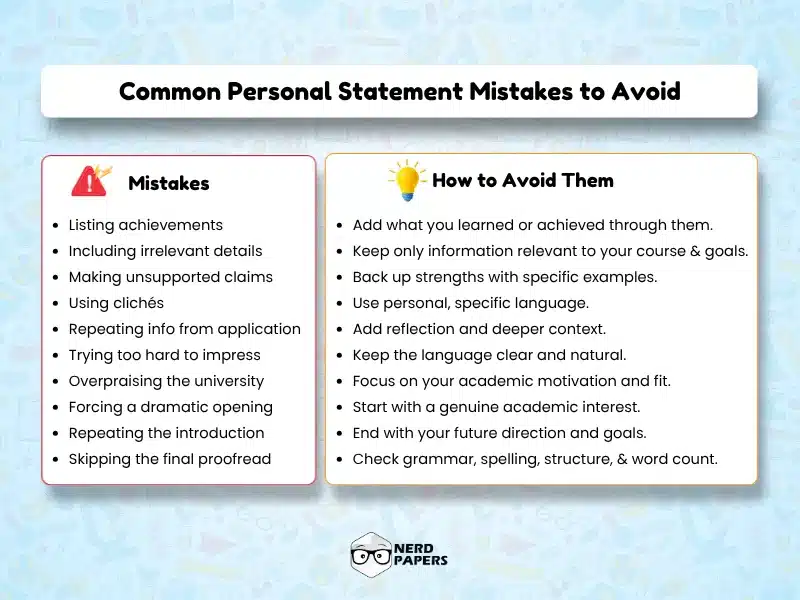
Listing Achievements Without Explaining Their Significance
A list of awards, projects, courses, or activities tells the reader what you have done but not what those experiences contributed to your development. For the strongest points, explain what you learned, how your thinking changed, or why the experience matters to the subject you want to study.
Including Too Many Unrelated Experiences
Trying to fit every accomplishment into the statement can weaken its focus. If an experience does not contribute to your academic motivation, preparation, development, or future direction, it may not deserve space.
Choose material for what it adds to your application, not simply because it happened.
Claiming Strengths Without Evidence
Describing yourself as hardworking, resilient, analytical, or independent is easy. Giving the reader a reason to reach that conclusion is more convincing.
Use specific actions and experiences to demonstrate important qualities. This is a key part of understanding how to write a personal statement that feels credible rather than self-promotional.
Relying on Clichés and Generic Statements
Phrases such as I have always been passionate about… or I want to make a difference can apply to thousands of applicants when they are left unexplained.
If you make a broad statement, follow it with the detail that makes it yours. Explain what created that interest, what you pursued because of it, or what you hope to understand further.
Repeating Information From the Rest of Your Application
Your personal statement should add meaning to the information admissions teams already have. Repeating grades, qualifications, and activities without adding context wastes an opportunity to explain what those experiences reveal about you.
Use the statement to provide the reasoning and reflection that a list of credentials cannot.
Trying Too Hard to Sound Impressive
Complicated vocabulary and overly formal sentences do not automatically make an application stronger. They can make straightforward ideas harder to understand and push your natural voice into the background.
Aim for precise language instead. The reader should notice the strength of your experiences and thinking, not how elaborate your vocabulary is.
Spending Too Much Space Praising the University
Researching the course is useful because it helps you understand what you are applying for and which parts of your background are relevant. Your statement, however, should primarily explain your motivation and preparation, not tell the university how prestigious or impressive it is.
Keep the focus on what you bring to the application and why the academic direction makes sense for you.
Overwriting the Opening
Students sometimes spend so much time searching for the perfect hook that the opening becomes dramatic, vague, or disconnected from the rest of the statement.
A specific academic interest or meaningful starting point is enough. When writing a personal statement, clarity in the first paragraph is more useful than an opening designed only to attract attention.
Repeating the Introduction in the Conclusion
The conclusion should not restate your opening in different words. By the end of the statement, you have provided new evidence and reflection, so the final paragraph should reflect that development.
Use it to show what you are ready to pursue next and why further study is the logical direction from what you have discussed.
Submitting Without a Final Proofread
Small errors can survive several rounds of revision, particularly when you have read the same draft repeatedly. Proofread the final version separately and check names, spelling, grammar, punctuation, formatting, and application limits.
Once those issues are addressed, there is one more question many applicants now face: where, if anywhere, AI fits into the personal statement writing process.
Can You Use AI When Writing a Personal Statement?
AI can be useful during parts of the planning and editing process, but your personal statement still needs to represent your own experiences, academic interests, and reasons for applying. Universities and application systems may also have their own rules on AI use, so check the guidance that applies to your application before using it.
Use AI as a Tool, Not as Your Personal Voice
When writing a personal statement, AI can be useful for tasks such as generating questions to help you brainstorm, identifying parts of a draft that are unclear, or pointing out where the structure feels disconnected.
The distinction is important. Asking AI to help you examine your own ideas is different from asking it to invent experiences, motivations, achievements, or reflections for you. Those details should come from your actual academic background and personal development.
Keep the Experiences and Reflection Your Own
A personal statement depends on details that are specific to you: what interested you, what you did, what you learned, and why those experiences influenced your academic direction. If AI supplies those parts, the statement can quickly become generic or misrepresent your application.
If you use AI while learning how to write a personal statement, use it to question or review material you have already developed. You might ask whether a paragraph clearly explains why an experience mattered, for example, and then decide yourself how the paragraph should be improved.
Check the Rules for Your Application
There is no single AI policy that applies to every college, university, or application system. Before submitting your statement, check the current rules for the institution and application route you are using.
If AI use is restricted, follow those restrictions. Even where certain uses are permitted, you remain responsible for the accuracy and authenticity of what you submit.
The final question should therefore be simple: Does this statement accurately represent my experiences, thinking, and academic motivation? If it does, the last step is to run through a final checklist before submission.
Final Personal Statement Checklist
Before submitting, read your statement once more with the application requirements beside you. At this stage, you are not looking for new ideas to add. You are checking whether the final version does what it needs to do clearly, accurately, and within the space available.
Application Requirements
- Have you answered the actual personal statement prompt?
- Is the statement within the required word or character limit?
- Have you followed the instructions for your university, college, or application system?
- Are course and program names accurate where mentioned?
Academic Motivation and Direction
- Is it clear why you want to study this subject?
- Have you explained what specifically interests you about the field?
- Does your interest come through in experiences and evidence rather than broad claims?
- Does the statement show what you want to explore or develop through further study?
Experiences and Evidence
- Have you chosen experiences because they are relevant rather than simply impressive?
- Does each major experience add something different to your application?
- Have you explained what you learned instead of only describing what you did?
- Can the reader see how your experiences have contributed to your academic preparation or development?
Skills and Personal Qualities
- Are important skills demonstrated through actual experiences?
- Have you removed unsupported claims such as I am hardworking or I am a natural leader?
- Are the qualities you demonstrate relevant to your development as a university student?
Structure and Flow
- Does each paragraph have a clear purpose?
- Do your ideas progress naturally rather than reading like a list?
- Are similar or repeated points combined or removed?
- Does the opening establish your direction?
- Does the conclusion move that direction forward rather than repeat the introduction?
Voice and Clarity
- Does the statement sound like something you would naturally say and stand behind?
- Have you replaced clichés and vague claims with specific details?
- Is the language clear without being overly formal or complicated?
- Have you removed sentences that sound impressive but add little meaning?
Final Accuracy Check
After writing a personal statement and revising the content, do one separate proofread for technical errors. Check spelling, grammar, punctuation, formatting, names, and factual details without making unnecessary last-minute rewrites.
Finally, read the statement as an admissions reader would. If they can clearly understand why this subject interests you, how you have prepared for it, what your experiences have taught you, and where you want to go next, the statement is doing its job.

Conclusion: Write a Personal Statement That Shows Where You Are Going
Learning how to write a personal statement is ultimately about making the connection between where your academic interest began, what you have done to develop it, and where you want to take it next. Your grades and qualifications show what you have achieved. The personal statement gives you room to explain what those experiences have meant for your development.
The strongest statements do not depend on having an extraordinary story or a long list of accomplishments. They select relevant experiences and give them meaning. When writing a personal statement, keep that progression clear: interest → preparation → experience → reflection → future direction.
By the end, an admissions reader should understand more than what you have studied or taken part in. They should understand why those experiences matter to you, how they have prepared you for further study, and why the course you are applying for makes sense as your next academic step.
Frequently Asked Questions About Writing a Personal Statement
How Do I Start Writing a Personal Statement?
Start by checking the application requirements and deciding what you want the admissions reader to understand about you. Clarify why you want to study the subject, then identify the experiences that best demonstrate your interest and preparation. Planning these points first makes the actual opening much easier to write.
What Should I Include in a Personal Statement?
Include details that demonstrate your academic motivation, preparation, development, and future direction. These may come from coursework, projects, independent reading, relevant achievements, extracurricular activities, or personal experiences. Do not simply list them. Explain what you learned and why each important experience matters to your application.
How Do I Write a Personal Statement for University?
When learning how to write a personal statement for university, build it around a clear academic direction. Explain why the subject interests you, use relevant experiences to show how you have prepared for it, reflect on what those experiences taught you, and connect them to what you want to pursue through further study.
How Long Should a Personal Statement Be?
There is no universal personal statement length. Universities, colleges, and application systems may set different word or character limits. Always check the current requirements for your specific application and use the available space to develop your strongest points.
How Can I Make My Personal Statement Stand Out?
Focus on specificity rather than trying to sound unusual. Use your own experiences, explain what you took from them, and show how your interests have developed. A thoughtful explanation of a relevant experience usually says more about you than a dramatic hook or a list of impressive achievements.
Should I Include Extracurricular Activities in My Personal Statement?
Yes, when they contribute something relevant to your application. An extracurricular activity may demonstrate initiative, responsibility, leadership, collaboration, or a sustained interest. When writing a personal statement, focus on what the experience reveals about your development rather than simply stating that you participated.
Can I Include Work Experience in a University Personal Statement?
Yes, if it has clear academic relevance. Work experience may have introduced you to an aspect of your intended field, developed useful transferable skills, or changed your understanding of the subject. Explain what you gained from the experience and how it contributes to your preparation for further study.
How Should I End My Personal Statement?
Use the ending to show where your interests and experiences are leading. Reinforce your readiness for further study and the academic areas you want to develop without repeating the introduction. The final paragraph should leave the reader with a clear sense of why the course is a logical next step for you.