Key Takeaways
Before you begin writing a compare and contrast essay, it helps to understand the process from start to finish. Keep these key points in mind as you work through this guide:
- A compare and contrast essay analyzes meaningful similarities and differences between two related subjects.
- The best essays begin with careful planning, not drafting.
- Choosing clear comparison criteria leads to stronger analysis and better organization.
- A focused thesis statement gives your comparison a clear direction.
- Both the Block Method and Point-by-Point Method are effective when used in the right situation.
- Supporting evidence should explain your comparisons rather than simply list facts.
- Transition words help readers move smoothly between similarities and differences.
- Revision improves clarity, strengthens analysis, and removes weak or repetitive comparisons.
- Following a structured writing process makes writing a compare and contrast essay easier and more effective.
- By the end of this guide, you’ll know how to write a compare and contrast essay that is balanced, analytical, and well-organized.
If you’re wondering how to write a compare and contrast essay, the process is much simpler than it first appears. A strong compare and contrast essay does more than identify similarities and differences. It evaluates them, explains their significance, and helps readers understand the relationship between two subjects through logical analysis and supporting evidence.
Whether you’re comparing two books, historical events, scientific theories, products, or ideas, success comes from following a clear structure rather than making random observations. This guide walks you through every stage of writing a compare and contrast essay, from choosing suitable subjects and creating a strong thesis statement to organizing body paragraphs, using evidence effectively, and polishing your final draft.
If you’re working with a tight deadline or a complex assignment, you can buy a professionally written compare and contrast essay that follows your instructions while using this guide to better understand the writing process.

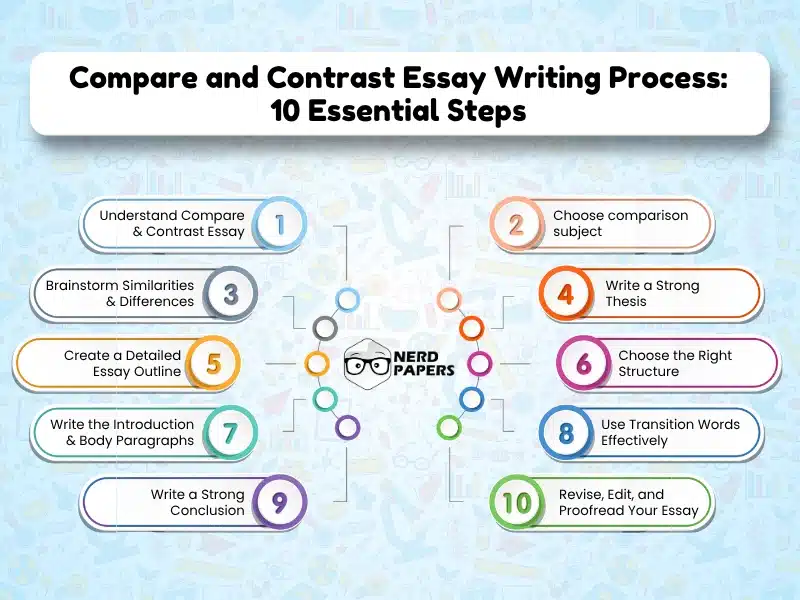
Compare and Contrast Essay Writing Process: 10 Essential Steps
Learning how to write a compare and contrast essay becomes easier when the process is broken into clear stages. Careful planning, logical organization, and thoughtful analysis help you move from selecting suitable subjects to producing a polished, evidence-based paper with balanced comparisons and meaningful conclusions.
Step 1: Understand What a Compare and Contrast Essay Is
Before learning how to write a compare and contrast essay, it’s important to understand what this type of academic writing is designed to accomplish. Many students assume the goal is simply to list similarities and differences, but an effective compare and contrast essay goes much further. It examines two related subjects, explains their relationship, and analyzes why those similarities and differences matter.
Unlike descriptive writing, writing a compare and contrast essay requires critical thinking and evaluation rather than simply presenting information about two subjects. Rather than presenting isolated facts, it organizes information around clear comparison criteria and develops a logical argument supported by evidence. This approach helps readers understand patterns, evaluate ideas, and draw informed conclusions.
At its core, a compare and contrast essay explores two connected subjects by examining both their shared characteristics and their distinguishing features. Depending on your assignment, those subjects might include literary works, historical figures, scientific concepts, business strategies, social issues, or everyday products. Regardless of the topic, the objective remains the same: provide an objective, balanced, and well-supported comparison.
Compare vs. Contrast
Although the two terms are often used together, they describe different parts of the analysis.
| Compare | Contrast |
| Identifies similarities between subjects | Identifies differences between subjects |
| Highlights shared characteristics | Explains unique characteristics |
| Shows common patterns or relationships | Shows distinctions and contrasts |
| Supports comparative analysis | Supports critical evaluation |
A successful compare and contrast essay combines both approaches instead of focusing heavily on one. Maintaining that balance allows your analysis to remain objective, coherent, and persuasive throughout the paper.
Step 2: Choose Subjects That Can Be Compared Effectively
The quality of your essay depends heavily on the subjects you choose. Before writing a compare and contrast essay, make sure both subjects share enough similarities to compare meaningfully while also having enough differences to produce insightful analysis. If there isn’t a clear basis for comparison, your essay can quickly become confusing or one-sided.
A useful comparison goes beyond placing two unrelated topics side by side. Instead, it examines subjects that belong to the same category or serve a similar purpose. For example, comparing two novels by the same author, two political systems, two marketing strategies, or two renewable energy sources gives you clear comparison points and allows for a deeper comparative analysis.
If you haven’t selected a topic yet, browsing a collection of compare and contrast essay topics can help you identify subjects that naturally lend themselves to balanced discussion before you begin planning your paper.
What Makes Two Subjects Comparable?
Choose subjects that:
- Belong to the same category or discipline.
- Share a common purpose, function, or theme.
- Have meaningful similarities and differences.
- Provide enough information or evidence for analysis.
- Allow for objective comparison using consistent criteria.
For example:
| Strong Comparison | Why It Works |
| Online learning vs. traditional classroom learning | Both aim to deliver education but use different approaches. |
| Android vs. iPhone | Similar purpose with different features, ecosystems, and user experiences. |
| Solar energy vs. wind energy | Both are renewable energy sources with distinct advantages and limitations. |
| Democracy vs. monarchy | Both are systems of governance with different structures and principles. |
Avoid Comparing Unrelated Subjects
One of the biggest mistakes students make when learning how to write a compare and contrast essay is choosing subjects simply because they seem interesting. Even if two topics are individually strong, they may not produce a meaningful comparison.
For example:
| Weak Comparison | Why It Doesn’t Work |
| Smartphones vs. Volcanoes | No logical relationship or shared comparison criteria. |
| Basketball vs. Climate Change | Completely different categories and purposes. |
| Shakespeare vs. Electric Cars | Insufficient common ground for analytical comparison. |
When subjects lack a logical connection, the essay often turns into two separate descriptions instead of one cohesive comparison.
Define Your Comparison Criteria Early
Once you’ve selected your subjects, identify the specific criteria you’ll use throughout the essay. These criteria become the foundation of your analysis and help keep every body paragraph focused.
Depending on your topic, you might compare subjects based on:
- Features or characteristics
- Purpose or function
- Advantages and disadvantages
- Causes and effects
- Performance or effectiveness
- Historical development
- Cost or value
- Social, cultural, or environmental impact
Using the same comparison criteria for both subjects creates a balanced discussion and makes your analysis easier for readers to follow.
After selecting two suitable subjects and deciding what you’ll compare, the next step is organizing your ideas. Brainstorming similarities, differences, and comparison criteria before drafting will help you build a clear roadmap for the rest of your essay.
Step 3: Brainstorm Similarities, Differences, and Comparison Criteria
Once you’ve chosen two suitable subjects, resist the urge to start writing immediately. One of the most overlooked parts of writing a compare and contrast essay is the planning stage. Spending a few minutes organizing your ideas before drafting makes it much easier to identify meaningful comparisons, avoid repetition, and build a logical structure.
The goal of brainstorming isn’t to collect as many similarities and differences as possible. Instead, it’s to identify the strongest comparison points that support your thesis and contribute to a balanced analysis.
Start by Listing Similarities and Differences
Begin by writing down everything the two subjects have in common and where they differ. At this stage, don’t worry about organization or paragraph structure. Focus on generating ideas first, then decide which ones are relevant to your essay.
Ask yourself questions such as:
- What characteristics do both subjects share?
- How do they differ in purpose, design, or function?
- What are their strengths and weaknesses?
- How do they produce different outcomes?
- Which differences have the greatest impact?
- Which similarities are most significant?
After brainstorming, remove weak or repetitive points and keep only the comparisons that contribute to your overall argument.
Use Visual Planning Tools to Organize Ideas
Visual organizers make it easier to see relationships between your subjects before you begin drafting. They also help ensure your discussion remains balanced instead of focusing too heavily on one subject.
Venn Diagram
A Venn diagram is one of the simplest tools for planning a compare and contrast essay. Place similarities in the overlapping section and differences in the outer sections. This method works particularly well for shorter assignments and introductory-level essays.
T-Chart
A T-chart divides your page into two columns, allowing you to list information about each subject side by side. It’s useful when comparing factual information, features, or characteristics before deciding which points deserve deeper analysis.
Comparison Matrix
For longer or more detailed essays, a comparison matrix provides greater organization. Instead of simply listing similarities and differences, it compares both subjects across the same set of criteria, making it easier to maintain consistency throughout the essay.
For example:
| Comparison Criteria | Online Learning | Traditional Classroom Learning |
| Purpose | Delivers education through digital platforms | Delivers education through face-to-face instruction |
| Learning Environment | Flexible and self-paced | Structured and instructor-led |
| Interaction | Virtual discussions, forums, and video meetings | In-person discussions and immediate feedback |
| Advantages | Greater flexibility, lower travel costs, access from anywhere | More direct interaction, hands-on activities, and classroom engagement |
| Limitations | Requires self-discipline and reliable internet access | Fixed schedules and commuting requirements |
| Overall Impact | Best for learners who value flexibility | Best for learners who prefer structured classroom environments |
Using the same comparison criteria for both subjects creates a logical framework that carries through every section of your essay.
Focus on Quality Rather Than Quantity
A common mistake when learning how to write a compare and contrast essay is believing that more comparison points automatically create a better paper. In reality, five well-developed comparisons supported by evidence are much stronger than ten brief observations with little analysis.
As you review your brainstorming notes, ask yourself:
- Does this point support my main argument?
- Can I explain why this similarity or difference matters?
- Do I have enough evidence to develop this comparison?
- Does this point add something new instead of repeating another idea?
If the answer is no, leave it out. Every comparison should have a clear purpose and contribute to the overall analysis.
Now that you’ve organized your ideas and identified meaningful comparison points, the next step is turning those observations into a focused thesis statement that gives your essay a clear direction.
Step 4: Write a Strong Compare and Contrast Thesis Statement
Your thesis statement is the foundation of your essay. It tells readers what you’re comparing, identifies the main focus of your analysis, and explains the point you’ll make throughout the paper. Without a clear thesis, even a well-researched compare and contrast essay can feel disconnected and difficult to follow.
When learning how to write a compare and contrast essay, many students make the mistake of writing a thesis that only states the subjects being compared. A stronger thesis goes one step further by presenting an analytical claim about the similarities, differences, or overall significance of the comparison.
What Makes a Strong Compare and Contrast Thesis?
An effective thesis statement should:
- Clearly identify the two subjects being compared.
- Establish the main comparison criteria.
- Present a specific analytical claim instead of a simple observation.
- Remain balanced by acknowledging both similarities and differences when appropriate.
- Guide the organization of the entire essay.
A good thesis doesn’t try to cover every comparison. Instead, it narrows the focus so each body paragraph supports one central argument.
Formula for Writing a Compare and Contrast Thesis Statement
When writing a compare and contrast essay, this simple thesis formula can help you turn your comparison into a focused analytical claim:
Although Subject A and Subject B share Similarity, they differ in Criteria 1, Criteria 2, and Criteria 3, making Analytical Claim.
This structure keeps your thesis specific while providing a clear roadmap for the rest of the essay.
Compare Weak and Strong Thesis Statements
| Weak Thesis | Strong Thesis |
| Online learning and traditional classroom learning are different. | Although online learning and traditional classroom learning both aim to educate students, they differ in flexibility, student interaction, and learning environments, making each approach better suited to different learning preferences. |
| Android and iPhone have many similarities and differences. | While Android and iPhone offer many of the same core smartphone functions, they differ significantly in customization, ecosystem integration, and software updates, influencing how users choose between them. |
| Public and private schools are not the same. | Public and private schools provide quality education through different funding models, class sizes, and curriculum flexibility, creating distinct learning experiences for students. |
Notice how the stronger examples don’t simply announce a comparison. They explain what will be compared and why those comparisons matter.
Common Thesis Statement Mistakes
Avoid these common problems when writing a compare and contrast essay:
- Simply announcing the topic: “This essay compares cats and dogs.”
- Making the thesis too broad: Trying to compare every possible similarity and difference.
- Focusing only on similarities or only on differences: A balanced analysis is usually more effective unless your assignment specifies otherwise.
- Using vague language: Phrases like better, nice, or different don’t explain your analytical position.
- Introducing ideas that never appear in the essay: Every point mentioned in the thesis should be discussed later in the body paragraphs.
Checklist for a Strong Thesis Statement
Before moving on, ask yourself:
- Have I clearly identified both subjects?
- Is my comparison focused instead of too broad?
- Have I established the comparison criteria?
- Does the thesis present an analytical claim rather than a factual statement?
- Can every body paragraph support this thesis?
If you can answer yes to each question, you’ve created a thesis that provides a strong foundation for the rest of your essay.
Once your thesis statement defines the direction of your argument, the next step is organizing your ideas into a clear outline. A well-planned structure ensures every comparison builds logically toward your conclusion.
Step 5: Create a Clear Compare and Contrast Essay Outline
When writing a compare and contrast essay, a well-structured outline serves as the blueprint for your argument. It helps organize your ideas, arrange comparison points logically, and ensure every section supports your thesis. Spending time on an outline also reduces repetition, improves paragraph flow, and makes the drafting process much more efficient.
If you’re still learning how to write a compare and contrast essay, planning the introduction, body paragraphs, and conclusion before drafting can prevent repetition and keep the comparison balanced. This creates a logical progression of ideas and ensures your comparisons remain balanced from beginning to end.
Why Outlining Matters
Creating an outline before drafting offers several advantages:
- Organizes your ideas into a logical sequence.
- Keeps every paragraph focused on your thesis statement.
- Prevents repetition and unnecessary information.
- Helps maintain a balanced discussion of both subjects.
- Makes it easier to identify missing evidence or weak comparison points before writing.
- Saves time during drafting and revision.
Basic Compare and Contrast Essay Framework
Although assignments may vary, most compare and contrast essays follow the same overall structure.
| Essay Section | Purpose |
| Introduction | Introduce both subjects, provide background information, and present a clear thesis statement. |
| Body Paragraphs | Compare the subjects using consistent comparison criteria, supporting evidence, and analysis. |
| Conclusion | Restate the thesis, summarize the main comparisons, and explain the overall significance of your analysis. |
Sample Compare and Contrast Essay Outline
Here’s a simple outline you can adapt for most assignments.
I. Introduction
- Hook
- Background information
- Introduce both subjects
- Thesis statement
II. Body
- Comparison Point 1
- Comparison Point 2
- Comparison Point 3
(The body can later be organized using either the Block Method or the Point-by-Point Method.)
III. Conclusion
- Restate the thesis
- Summarize the main comparisons
- Leave readers with a final insight
Plan Before You Draft
Before moving on to the first draft, review your outline and ask yourself:
- Does every comparison support my thesis?
- Have I chosen consistent comparison criteria?
- Will each body paragraph discuss a single comparison point clearly?
- Is the discussion balanced between both subjects?
- Do I know where my evidence will be included?
Answering these questions now makes the drafting stage much smoother and helps you avoid major revisions later.
With your outline complete, the next decision is how to organize your comparisons. The two most common approaches are the block method and the point-by-point method, each offering a different way to present similarities and differences while maintaining a logical flow.
Step 6: Choose the Best Compare and Contrast Essay Structure
Once your outline is complete, the next step is deciding how your comparisons will be organized. The structure you choose affects the flow of your essay, how easily readers follow your ideas, and how effectively you present your analysis.
When writing a compare and contrast essay, you can usually organize your comparison using one of two methods: the block method or the point-by-point method. Both are widely accepted in academic writing, but each works better in different situations. Understanding how they differ will help you select the structure that best fits your assignment and writing style.
Block Method (Subject-by-Subject Method)
The block method, also known as the subject-by-subject method, discusses one subject in its entirety before moving on to the second subject. Instead of switching back and forth between ideas, you explain all the relevant points about Subject A first, followed by Subject B.
This method works well when readers need a clear understanding of each subject before comparing them or when your assignment focuses on providing detailed background information.
Block Method Structure
| Section | Content |
| Introduction | Hook, background information, and thesis statement |
| Body Paragraphs (Subject A) | Comparison Point 1, Point 2, Point 3 |
| Body Paragraphs (Subject B) | Comparison Point 1, Point 2, Point 3 |
| Conclusion | Restate the thesis and summarize the comparison |
Comparing Online Learning and Traditional Classroom Learning
Subject A: Online Learning
- Flexibility
- Student interaction
- Learning resources
Subject B: Traditional Classroom Learning
- Flexibility
- Student interaction
- Learning resources
Although the same comparison criteria are used, each subject is discussed separately before readers compare them.
Advantages of the Block Method
- Easy to organize and follow.
- Suitable for shorter essays.
- Allows detailed discussion of each subject.
- Helpful when readers need background information before comparing.
Limitations of the Block Method
- Readers may forget details from the first subject before reaching the second.
- Similarities and differences are less immediate.
- Requires strong transitions to connect both sections effectively.
Point-by-Point Method (Alternating Method)
The point-by-point method, sometimes called the alternating method, compares both subjects under each comparison criterion instead of discussing them separately. Every body paragraph focuses on one comparison point, making it easier for readers to evaluate similarities and differences immediately.
Because this method emphasizes direct comparison throughout the essay, it is the structure most instructors recommend for analytical assignments.
Point-by-Point Structure
| Section | Content |
| Introduction | Hook, background information, and thesis statement |
| Body Paragraph 1 | Comparison Point 1 (Subject A vs. Subject B) |
| Body Paragraph 2 | Comparison Point 2 (Subject A vs. Subject B) |
| Body Paragraph 3 | Comparison Point 3 (Subject A vs. Subject B) |
| Conclusion | Restate the thesis and summarize the comparison |
Comparing Online Learning and Traditional Classroom Learning
Body Paragraph 1: Flexibility
- Online Learning
- Traditional Classroom Learning
Body Paragraph 2: Student Interaction
- Online Learning
- Traditional Classroom Learning
Body Paragraph 3: Learning Resources
- Online Learning
- Traditional Classroom Learning
This approach allows readers to compare each criterion immediately instead of remembering information from earlier sections.
Advantages of the Point-by-Point Method
- Creates stronger and more direct comparisons.
- Keeps both subjects balanced throughout the essay.
- Improves logical flow and analytical depth.
- Makes similarities and differences easier to evaluate.
Limitations of the Point-by-Point Method
- Requires more planning before drafting.
- Can become repetitive if every paragraph follows the same sentence pattern.
- Depends on consistent comparison criteria for a smooth flow.
Block Method vs. Point-by-Point Method
Knowing how to write a compare and contrast essay also means choosing a structure that fits your assignment, subjects, and expected level of analysis.
| Feature | Block Method | Point-by-Point Method |
| Organization | Discusses one subject completely before the other. | Compares both subjects under each comparison point. |
| Best For | Essays requiring detailed background information. | Essays focused on analytical comparison. |
| Reader Experience | Comparisons are made after both subjects are discussed. | Comparisons are made continuously throughout the essay. |
| Analysis | Moderate | More detailed and analytical. |
| Planning Required | Less | More |
Which Structure Should You Choose?
If your subjects require extensive explanation before they can be compared, the block method is often the better choice. It provides readers with the necessary context before moving into the comparison.
However, if your goal is to produce a balanced, analytical essay where similarities and differences are evaluated side by side, the point-by-point method is usually the stronger option. Since readers can compare each criterion immediately, this structure creates a smoother flow and often results in a more cohesive argument.
Regardless of which method you choose, keep your comparison criteria consistent, support every point with evidence, and ensure that each paragraph contributes to your thesis rather than simply listing similarities and differences.
Now that you’ve selected the organizational method for your essay, it’s time to start drafting. The next step explains how to write an engaging introduction and develop body paragraphs that combine strong analysis with well-supported comparisons.
Step 7: Write an Engaging Introduction and Well-Organized Body Paragraphs
With your outline and organizational method in place, it’s time to begin drafting. A strong compare and contrast essay starts with an introduction that captures the reader’s attention and clearly presents your main argument. It then develops that argument through well-organized body paragraphs that compare ideas using consistent criteria, supporting evidence, and thoughtful analysis.
Whether you’re writing a compare and contrast essay for school or college, every section should connect naturally to your thesis and build your comparison step by step.
Writing an Effective Introduction
The introduction creates the first impression of your essay. Its purpose is to introduce the subjects, provide enough background for readers to understand the topic, and lead naturally to your thesis statement.
A strong introduction typically includes four elements:
- A hook that captures the reader’s interest.
- Brief background information about the subjects.
- A smooth transition from the background to the comparison.
- A clear and focused thesis statement.
Example Introduction Structure
| Part | Purpose |
| Hook | Capture the reader’s attention with a question, fact, or interesting statement. |
| Background | Introduce the two subjects and explain why they are being compared. |
| Transition | Narrow the discussion toward the main comparison. |
| Thesis Statement | Present the central comparison and analytical claim. |
Keep your introduction concise. Avoid explaining every similarity and difference upfront, as those points belong in the body paragraphs.
Organize Body Paragraphs Around One Comparison Point
When writing a compare and contrast essay, the body paragraphs are where your comparison develops into actual analysis. Rather than discussing random similarities and differences, each paragraph should focus on one comparison criterion that supports your thesis.
For example, if you’re comparing online learning and traditional classroom learning, one paragraph might discuss flexibility, another student interaction, and another learning resources.
This approach keeps your essay focused and prevents ideas from overlapping.
A well-developed body paragraph should include:
- A clear topic sentence.
- The comparison point.
- Evidence for both subjects.
- Analysis explaining the significance of the comparison.
- A transition to the next paragraph.
Example Body Paragraph Structure
| Paragraph Element | Purpose |
| Topic Sentence | Introduce the comparison point. |
| Subject A | Present evidence and analysis. |
| Subject B | Present evidence and analysis. |
| Comparison | Explain the similarity or difference and why it matters. |
| Closing Sentence | Connect the paragraph to the next comparison point. |
Following the same structure throughout your essay creates consistency and improves readability.
Support Every Comparison with Evidence
One of the most common mistakes when learning how to write a compare and contrast essay is relying on personal opinions instead of evidence. Readers should understand not only what is similar or different but also why those comparisons are valid.
Depending on your assignment, you can strengthen your analysis with:
- Facts
- Statistics
- Research findings
- Textual evidence
- Historical evidence
- Literary evidence
- Case studies
- Expert opinions
- Real-world examples
- Direct quotations (when appropriate)
Choose evidence that directly supports your comparison rather than adding information that doesn’t contribute to your argument.
Focus on Analysis Instead of Description
Strong compare and contrast essay writing goes beyond describing each subject separately. After presenting evidence, explain what it reveals about the relationship between the two subjects.
For example, instead of writing: Both online learning and traditional classroom learning provide educational opportunities.
Develop the comparison further: Although both online learning and traditional classroom learning aim to educate students, online courses offer greater scheduling flexibility, whereas traditional classrooms provide more immediate face-to-face interaction. These differences influence student engagement and learning preferences depending on individual needs.
Notice that the second example doesn’t stop at identifying a difference. It explains its significance, creating a stronger comparative analysis.
Maintain Balance Throughout the Essay
A compare and contrast essay should give both subjects equal attention. Spending three paragraphs discussing one subject and only one paragraph discussing the other creates an unbalanced comparison that weakens your argument.
As you draft, check that:
- Both subjects receive similar levels of discussion.
- Every comparison uses the same criteria.
- Evidence is presented fairly for both sides.
- Paragraph lengths remain reasonably consistent.
- The analysis supports your thesis instead of introducing unrelated ideas.
See How These Elements Work Together
If you’d like to see how all these elements come together in a finished paper, reviewing a few well-written comparison essay examples can help you understand how strong introductions, organized body paragraphs, supporting evidence, and conclusions work together in practice.
Once your introduction and body paragraphs are complete, the next step is improving the flow of your writing with effective transition words that connect similarities, differences, and ideas naturally from one paragraph to the next.
Step 8: Use Compare and Contrast Transition Words Effectively
Even the strongest ideas can feel disconnected if they aren’t linked with clear transitions. Transition words help readers understand when you’re discussing similarities, introducing differences, adding supporting information, or moving from one comparison point to the next. They create a smoother reading experience and improve the overall flow of your essay.
When writing a compare and contrast essay, transitions should feel natural rather than forced. Instead of adding them simply for variety, use them to show the relationship between ideas and guide readers through your analysis.
Transition Words for Showing Similarities
Use these transitions when discussing characteristics that both subjects share.
| Transition Word | Example |
| Similarly | Similarly, both learning methods encourage independent study. |
| Likewise | Likewise, both smartphones offer advanced security features. |
| In the same way | In the same way, each policy aims to reduce environmental impact. |
| Equally | Equally important, both novels explore themes of identity. |
| Both | Both approaches require careful planning and preparation. |
These transitions help readers recognize shared characteristics without making your comparisons repetitive.
Transition Words for Showing Differences
Use these expressions when introducing contrasting ideas or explaining how the subjects differ.
| Transition Word | Example |
| However | However, online learning provides greater scheduling flexibility. |
| In contrast | In contrast, classroom learning offers immediate face-to-face interaction. |
| Whereas | Whereas one solution focuses on affordability, the other emphasizes performance. |
| On the other hand | On the other hand, electric vehicles require charging infrastructure. |
| Conversely | Conversely, the second strategy prioritizes long-term growth over short-term results. |
| Nevertheless | Nevertheless, both methods remain effective in different situations. |
These transition words make it easier for readers to distinguish between comparison points while maintaining a logical progression of ideas.
Use Transitions Between Paragraphs
Transitions aren’t limited to individual sentences. They also connect body paragraphs and help readers follow your overall argument.
For example:
- After discussing one comparison point, briefly summarize the main idea before introducing the next.
- Refer back to the thesis when moving from similarities to differences.
- Maintain the same comparison criteria throughout the essay so each transition feels purposeful.
This approach creates a natural flow instead of making each paragraph feel isolated.
Don’t Overuse Transition Words
Although transitions improve readability, using the same words repeatedly can make your writing sound mechanical. For example, beginning every sentence with however or similarly quickly becomes repetitive.
Instead:
- Alternate between different transition words with similar meanings.
- Choose transitions that accurately reflect the relationship between ideas.
- Keep transitions concise and relevant to the comparison.
- Focus on smooth sentence flow rather than inserting transition words wherever possible.
Understanding how to write a compare and contrast essay effectively includes knowing how to guide readers between similarities and differences without making transitions feel forced.
After improving the flow of your essay, the final piece is writing a conclusion that reinforces your comparison, summarizes your main findings, and leaves readers with a clear understanding of your overall analysis.
Step 9: Write a Strong Conclusion
When writing a compare and contrast essay, your conclusion is the final opportunity to reinforce the central comparison and leave readers with a clear understanding of your analysis. Instead of introducing new information, it should bring together the main comparison points, restate your thesis in a fresh way, and explain why the comparison matters.
Part of learning how to write a compare and contrast essay is knowing how to bring the comparison back to your central argument rather than simply repeating earlier points. Whether you’re comparing historical events, literary works, scientific concepts, or everyday products, the conclusion should emphasize the insights gained from the comparison rather than simply repeating earlier points.
What Should a Compare and Contrast Essay Conclusion Include?
An effective conclusion typically includes the following elements:
- Restate your thesis using different wording.
- Summarize the most important similarities and differences.
- Reinforce the significance of your comparison.
- End with a thoughtful final observation that relates to the overall topic.
Keep your conclusion concise and focused. Most essays only need one well-developed paragraph to wrap up the discussion effectively.
Weak vs. Strong Conclusion
Understanding the difference between a weak and effective conclusion can help you avoid one of the most common mistakes in compare and contrast essay writing.
| Weak Conclusion | Strong Conclusion |
| Online learning and traditional classroom learning have many similarities and differences. That’s why they are both important. | Although online learning and traditional classroom learning share the same educational goal, they differ in flexibility, interaction, and learning environments. Understanding these differences allows students to choose the approach that best fits their individual needs and learning preferences. |
| Android and iPhone are different phones with different features. | While Android and iPhone offer many of the same core functions, their differences in customization, ecosystem integration, and software experience influence how users evaluate and choose between them. |
The stronger examples summarize the analysis and explain why the comparison is meaningful instead of repeating obvious facts.
Mistakes to Avoid in Your Conclusion
As you finish writing a compare and contrast essay, avoid these common mistakes:
- Introducing new comparison points or evidence.
- Repeating the thesis word for word.
- Simply listing similarities and differences again.
- Ending the essay abruptly without reinforcing the main idea.
- Using vague closing statements that don’t connect to the discussion.
Instead, focus on bringing your analysis together and showing readers what they should take away from your comparison.
Checklist for a Strong Conclusion
Before submitting your essay, make sure your conclusion:
- Restates the thesis without copying it exactly.
- Summarizes the key comparison points.
- Highlights the overall significance of the comparison.
- Maintains the same objective tone as the rest of the essay.
- Ends with a clear and meaningful closing statement.
A thoughtful conclusion leaves readers with a stronger understanding of your comparison and reinforces the purpose of the entire essay.
After writing the conclusion of your essay, the final stage is reviewing your work. Careful revision, editing, and proofreading will help you strengthen your analysis, improve clarity, and eliminate mistakes before submission.
Step 10: Revise, Edit, and Proofread Your Essay
Finishing your first draft doesn’t mean your essay is ready to submit. The final stage of writing a compare and contrast essay is reviewing your work carefully to improve its organization, strengthen your analysis, and eliminate mistakes that could affect clarity. Revising, editing, and proofreading each serve a different purpose, and completing all three helps transform a good draft into a polished academic paper.
Rather than correcting everything at once, review your essay in stages. Start with the overall content and organization before focusing on sentence-level improvements and grammar.
Revise Your Content and Analysis
Revision focuses on improving the quality of your ideas rather than correcting grammar or spelling. Read your essay as a whole and evaluate whether your comparisons are logical, balanced, and well supported.
Ask yourself the following questions:
- Does the thesis clearly reflect the main comparison?
- Does every body paragraph support the thesis?
- Are the comparison criteria applied consistently throughout the essay?
- Have I explained why each similarity or difference is important?
- Does the analysis go beyond simply describing both subjects?
- Are both subjects discussed with equal depth?
If a paragraph doesn’t strengthen your argument or repeats information you’ve already covered, revise or remove it.
Edit for Clarity and Organization
Once you’re satisfied with the overall content, edit your essay to improve readability. The goal is to make every sentence clear, concise, and logically connected.
Pay attention to:
- Paragraph organization
- Topic sentences
- Transition words
- Sentence variety
- Repetitive wording
- Consistent terminology
- Overall flow between paragraphs
Reading your essay from beginning to end can help you identify awkward transitions or sections where ideas feel disconnected.
Proofread for Grammar and Formatting
Proofreading is the final review before submission. At this stage, focus on correcting small errors that can reduce the professionalism of your work.
Check for:
- Grammar mistakes
- Spelling errors
- Punctuation
- Capitalization
- Sentence fragments
- Subject-verb agreement
- Citation formatting
- Typographical errors
If your instructor requires APA, MLA, Chicago, or another citation style, make sure every in-text citation and reference follows the required formatting guidelines.
Compare and Contrast Essay Revision Checklist
Once you understand how to write a compare and contrast essay, use this final revision checklist to make sure none of the essential elements has been overlooked.
| Revision Checklist | ✓ |
| My thesis clearly presents the main comparison. | ☐ |
| The essay follows a logical structure. | ☐ |
| Every body paragraph focuses on one comparison point. | ☐ |
| Both subjects receive balanced discussion. | ☐ |
| Every comparison is supported with relevant evidence. | ☐ |
| The analysis explains why the similarities and differences matter. | ☐ |
| Transition words connect ideas smoothly. | ☐ |
| Repetitive or unnecessary information has been removed. | ☐ |
| Grammar, spelling, and punctuation have been checked. | ☐ |
| Citations and formatting follow the required style guide. | ☐ |
Taking a few extra minutes to complete this checklist can significantly improve the quality of your essay and help you catch mistakes that are easy to overlook during drafting.
Now that you’ve completed every stage of the writing process, the following sections provide a practical checklist, common mistakes to avoid, and expert tips to help you review your work and produce a stronger compare and contrast essay.
Compare and Contrast Essay Writing Checklist
The final part of writing a compare and contrast essay is checking whether the thesis, structure, evidence, analysis, and comparisons work together as intended. A simple checklist can help you identify missing details, strengthen weak sections, and ensure your essay follows a logical structure. Whether you’re completing a classroom assignment or a college paper, reviewing your work systematically reduces avoidable mistakes and improves the overall quality of your writing.
Use the checklist below to confirm that your essay is clear, balanced, and ready for submission.
Planning and Organization
☐ I selected two subjects with meaningful similarities and differences.
☐ I established clear comparison criteria before drafting.
☐ My essay follows a logical structure from introduction to conclusion.
☐ I consistently used either the block method or the point-by-point method throughout the essay.
Introduction and Thesis Statement
☐ My introduction provides enough background without giving away the entire discussion.
☐ My thesis clearly identifies both subjects and presents a focused analytical claim.
☐ The thesis reflects the comparison criteria discussed in the body paragraphs.
Body Paragraphs
☐ Each paragraph focuses on one comparison point.
☐ Both subjects receive equal attention throughout the essay.
☐ Every comparison is supported with relevant evidence or examples.
☐ My analysis explains why the similarities and differences matter instead of simply describing them.
☐ The discussion stays focused on the thesis.
Evidence and Analysis
☐ I included reliable facts, examples, research findings, or textual evidence where appropriate.
☐ Every piece of evidence supports the comparison being discussed.
☐ I explained the significance of each comparison instead of leaving evidence unexplained.
☐ My comparisons are objective, balanced, and consistent.
Flow and Readability
☐ Topic sentences introduce each comparison clearly.
☐ Transition words connect ideas naturally within and between paragraphs.
☐ The essay flows smoothly from one comparison point to the next.
☐ Repetitive ideas and unnecessary information have been removed.
Revision and Proofreading
☐ Grammar, spelling, and punctuation have been checked.
☐ Sentence structure is clear and easy to follow.
☐ Formatting follows my instructor’s requirements.
☐ In-text citations and references are correctly formatted.
☐ I reviewed the essay one final time before submission.
Quick Self-Assessment
Before you submit your essay, ask yourself these five questions:
- Does my thesis clearly explain what I’m comparing and why?
- Have I discussed both subjects fairly and using the same comparison criteria?
- Does every body paragraph contribute to my overall argument?
- Have I supported my comparisons with relevant evidence instead of opinions alone?
- Will a reader be able to follow my comparisons without confusion?
If you can confidently answer yes to each question, your compare and contrast essay is likely well organized, analytical, and ready to submit.
Even with a strong draft and a completed checklist, certain mistakes can weaken your analysis. The next section highlights the most common pitfalls students face and explains how to avoid them.
Common Mistakes to Avoid When Writing a Compare and Contrast Essay
Even if you understand how to write a compare and contrast essay, a few common mistakes can reduce the quality of your work. Many students focus so much on identifying similarities and differences that they overlook analysis, organization, or balance. Recognizing these pitfalls before you submit your paper will help you produce a clearer, more effective essay.
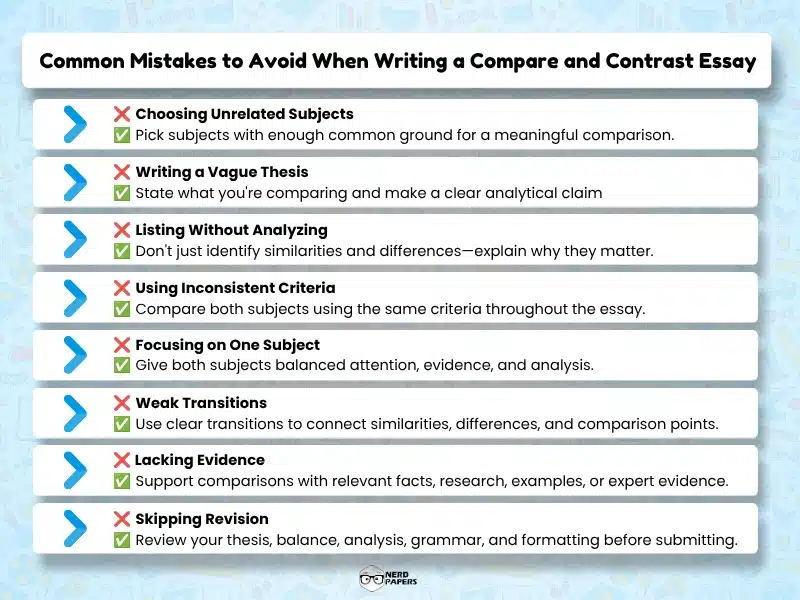
1. Choosing Subjects That Don’t Belong Together
A meaningful comparison starts with choosing subjects that share a logical relationship. Comparing unrelated topics often leads to forced comparisons and weak analysis because there isn’t enough common ground to discuss.
Instead of this:
- Smartphones vs. Volcanoes
- Basketball vs. Climate Change
Choose subjects like:
- Android vs. iPhone
- Online Learning vs. Traditional Classroom Learning
- Democracy vs. Monarchy
The stronger the connection between your subjects, the easier it is to build meaningful comparisons.
2. Writing a Weak or Vague Thesis Statement
Your thesis should do more than announce the topic. It should explain what you’re comparing and present a clear analytical claim.
Weak Thesis
Online learning and classroom learning are different.
Improved Thesis
Although online learning and traditional classroom learning pursue the same educational goals, they differ in flexibility, student interaction, and learning environments, making each approach suitable for different types of learners.
A focused thesis provides direction for every section of your essay.
3. Listing Similarities and Differences Without Analysis
One of the biggest mistakes students make is turning their essay into a list of observations.
For example:
❌ Weak
Both smartphones have high-quality cameras. Android allows more customization. iPhones receive updates regularly.
✅ Better
While both smartphones offer advanced camera systems, Android devices provide greater customization, whereas iPhones emphasize seamless software integration and long-term updates. These differences influence how users prioritize flexibility, security, and overall user experience.
Always explain why the comparison matters rather than stopping after identifying it.
4. Using Inconsistent Comparison Criteria
Your body paragraphs should compare both subjects using the same standards. Switching between unrelated criteria creates an uneven discussion and makes your essay harder to follow.
For example, if you compare online learning and classroom learning using flexibility, interaction, and accessibility, continue using those same criteria throughout the essay instead of introducing unrelated points midway through your discussion.
Consistency helps readers follow your argument from beginning to end.
5. Giving More Attention to One Subject
A compare and contrast essay should examine both subjects fairly. Spending significantly more time discussing one subject can make your comparison feel incomplete or biased.
As you revise, check that:
- Both subjects appear throughout the essay.
- Similar amounts of evidence support each subject.
- Paragraphs remain balanced in length and depth.
- Every comparison reflects both perspectives.
Balanced discussion strengthens your credibility and creates a more objective analysis.
6. Using Weak Transitions Between Ideas
Even strong comparisons can feel disconnected without effective transitions.
Avoid jumping abruptly between ideas. Instead, use transition words and clear topic sentences to show whether you’re introducing a similarity, highlighting a difference, or moving to the next comparison point.
Smooth transitions improve readability and make your analysis easier to follow.
7. Supporting Claims with Little or No Evidence
Comparisons should be supported by relevant evidence rather than personal opinions or assumptions.
Depending on your topic, support your analysis with:
- Facts
- Statistics
- Research findings
- Literary evidence
- Historical examples
- Case studies
- Expert opinions
Evidence strengthens your argument and demonstrates that your conclusions are based on credible information.
8. Skipping Revision and Proofreading
Many students finish their first draft and submit it immediately. However, small grammar mistakes, repetitive wording, unclear transitions, and formatting errors can reduce the overall quality of an otherwise strong essay.
Before submitting your work, review it carefully to ensure that:
- The thesis remains consistent throughout the essay.
- Every paragraph supports the main argument.
- Comparisons are logical and balanced.
- Grammar and punctuation are correct.
- Formatting follows your instructor’s requirements.
A final review often reveals issues that are difficult to notice while drafting.
How to Avoid These Mistakes
The easiest way to avoid these problems when writing a compare and contrast essay is to follow a structured process from topic selection through final revision. Start with carefully selected subjects, create a focused thesis, organize your ideas before drafting, support every comparison with evidence, and leave enough time to revise your work. Paying attention to these fundamentals will help you write a compare and contrast essay that is organized, analytical, and easy for readers to follow.
Avoiding common mistakes is only part of the writing process. The next section shares practical strategies that can help you strengthen your comparisons, improve your analysis, and make your essay more engaging from introduction to conclusion.
Tips to Improve Your Compare and Contrast Essay
Learning how to write a compare and contrast essay is only the first step. What separates an average essay from an excellent one is the quality of the analysis, the organization of ideas, and the clarity of the writing. The following tips will help you strengthen your comparisons, present stronger arguments, and produce a more polished final draft.
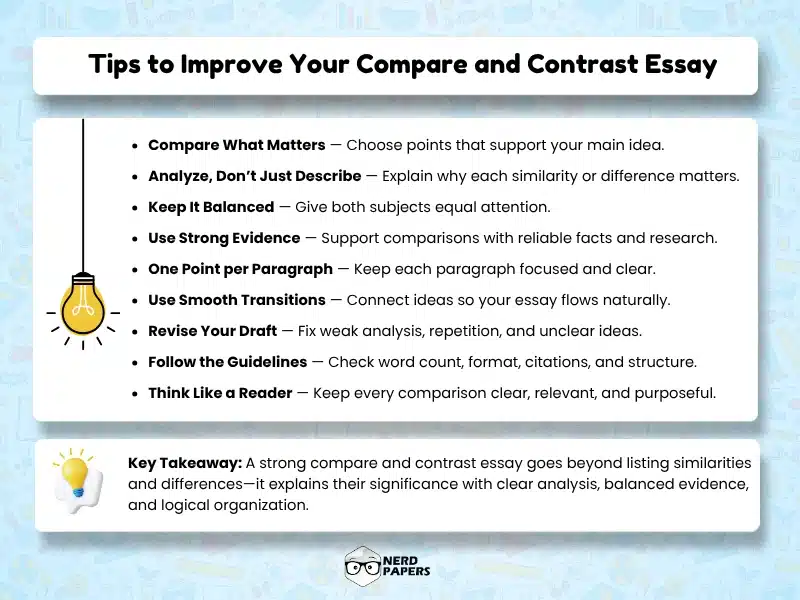
Choose Comparison Criteria That Matter
Not every similarity or difference deserves equal attention. Instead of comparing obvious or superficial characteristics, focus on points that help readers better understand the relationship between the two subjects.
For example, if you’re comparing two educational systems, discussing teaching methods, student engagement, and learning outcomes will provide more meaningful analysis than comparing classroom colors or school uniforms.
Ask yourself:
- Does this comparison support my thesis?
- Does it help readers understand the subjects more deeply?
- Is it significant enough to develop into a complete paragraph?
Prioritize Analysis Over Description
Strong analysis is central to writing a compare and contrast essay because the goal isn’t simply to describe two subjects. It explains what the similarities and differences reveal and why they matter.
Whenever you present evidence, follow it with analysis that answers questions such as:
- Why is this comparison important?
- What conclusion can readers draw?
- How does this support my thesis?
The more time you spend interpreting your comparisons rather than describing them, the stronger your essay will become.
Keep Your Comparison Balanced
An effective comparison gives both subjects equal attention. If one subject dominates the discussion, readers may feel the analysis is incomplete or biased.
As you review your essay, check that:
- Each comparison point discusses both subjects.
- Similar amounts of evidence support each side.
- Paragraphs remain balanced in length and detail.
- Neither subject is overlooked in the conclusion.
Maintaining balance improves objectivity and makes your argument more convincing.
Use Reliable Evidence to Support Your Analysis
Evidence strengthens your comparisons and makes your conclusions more credible. Depending on your topic, support your discussion with:
- Academic research
- Statistics
- Historical examples
- Literary evidence
- Case studies
- Expert opinions
- Credible real-world examples
Avoid making broad claims unless you can support them with relevant evidence.
Make Every Paragraph Serve One Purpose
If you’re learning how to write a compare and contrast essay clearly, start by giving each body paragraph one specific comparison point to develop. Trying to compare multiple unrelated ideas within the same paragraph often makes the discussion difficult to follow.
A simple structure works well:
- Introduce the comparison point.
- Compare both subjects.
- Present supporting evidence.
- Explain the significance of the comparison.
- Transition to the next point.
Following the same pattern throughout your essay creates consistency without making the writing feel repetitive.
Write Clear and Natural Transitions
Transitions should guide readers through your discussion instead of interrupting it. Rather than inserting transition words randomly, use them to show clear relationships between ideas and maintain a logical flow from one paragraph to the next.
Good transitions make your essay feel connected, helping readers move smoothly between similarities, differences, and new comparison points.
Revise More Than Once
Strong essays are rarely written in a single draft. After completing your first version, step away from it for a while before reviewing it again. Looking at your work with fresh eyes makes it easier to identify unclear explanations, repetitive wording, weak transitions, and areas where your analysis could be developed further.
If possible, ask someone else to read your essay. A second reader can often spot issues that are easy to miss when you’ve been working on the same paper for a long time.
Match Your Writing to the Assignment Requirements
Before submitting your essay, review your instructor’s guidelines one final time. Check that you’ve followed the required:
- Essay length
- Formatting style
- Citation style
- Organizational structure
- Submission requirements
Even a well-written essay can lose marks if it doesn’t meet the assignment instructions.
Keep the Reader in Mind
As you revise, read your essay from the perspective of someone unfamiliar with the topic. Every paragraph should answer the reader’s questions clearly, every comparison should have a purpose, and every conclusion should naturally follow from the evidence you’ve presented.
Focusing on clarity, logical organization, and thoughtful analysis will help you produce a compare and contrast essay that is both engaging to read and academically effective.
Now that you understand the complete writing process, the final section brings everything together with a concise conclusion that reinforces the key ideas covered throughout this guide.

Wrapping Up: How to Write a Compare and Contrast Essay
Learning how to write a compare and contrast essay becomes much more manageable when you approach it as a structured process rather than trying to write everything at once. From choosing two comparable subjects and developing a focused thesis to organizing your ideas, supporting your analysis with evidence, and revising your final draft, each step contributes to a stronger and more convincing essay.
The key to successful compare and contrast essay writing is moving beyond simply identifying similarities and differences. A well-developed essay explains why those comparisons matter, uses consistent comparison criteria, and presents balanced analysis supported by credible evidence. Whether you choose the block method or the point-by-point method, maintaining a logical structure and clear transitions will make your ideas easier for readers to follow.
As you continue writing a compare and contrast essay, remember that strong planning often leads to stronger results. Taking the time to create an outline, refine your thesis, and review your work carefully will improve both the quality of your analysis and the clarity of your writing. By applying the techniques covered in this guide, you’ll be better prepared to write compare and contrast essays that are organized, insightful, and academically effective.
Frequently Asked Questions
1. How do you write a compare and contrast essay?
To understand how to write a compare and contrast essay, start by choosing two subjects with meaningful similarities and differences. Brainstorm comparison points, develop a clear thesis statement, create an outline, choose an organizational method such as the Block Method or Point-by-Point Method, and support every comparison with relevant evidence. Finish by revising and proofreading your essay to improve clarity and organization.
2. What is the best structure for a compare and contrast essay?
The best structure depends on your assignment and topic. The point-by-point method is generally preferred because it compares both subjects under each criterion, making similarities and differences easier to follow. The block method works well when readers need detailed background information about each subject before comparing them.
3. What is the difference between the Block Method and the Point-by-Point Method?
The Block Method discusses one subject completely before moving on to the second subject. In contrast, the Point-by-Point Method compares both subjects one comparison criterion at a time. While both structures are effective, the Point-by-Point Method usually creates a more direct and balanced comparison.
4. How many similarities and differences should a compare and contrast essay include?
There is no fixed number. Most essays focus on three to five meaningful comparison points, but the exact number depends on your assignment requirements and word count. Prioritize quality over quantity by developing each comparison with clear analysis and supporting evidence.
5. What should a compare and contrast thesis statement include?
A strong thesis statement should identify the two subjects being compared, establish the main comparison criteria, and present an analytical claim. Rather than simply stating that two subjects are similar or different, it should explain the significance of the comparison and guide the direction of the essay.
6. What transition words should I use in a compare and contrast essay?
Use transition words that clearly show relationships between ideas. For similarities, words like similarly, likewise, and in the same way work well. For differences, use however, whereas, in contrast, conversely, or on the other hand to help readers follow your comparisons smoothly.
7. What are the most common mistakes when writing a compare and contrast essay?
Some of the most common mistakes include choosing unrelated subjects, writing a weak thesis statement, listing similarities and differences without analysis, using inconsistent comparison criteria, creating an unbalanced discussion, and failing to support comparisons with evidence. Careful planning and revision can help you avoid these issues.
8. How do you end a compare and contrast essay?
End your essay by restating the thesis in different words, summarizing the most important comparisons, and explaining why those similarities and differences matter. Avoid introducing new evidence or arguments in the conclusion, and leave readers with a final insight that reinforces your overall analysis.