
Key Takeaways
- A dissertation is an extended academic research project that investigates a focused research question or problem using scholarly evidence, an appropriate methodology, and critical analysis.
- The purpose of a dissertation is to show that a student can conduct independent research, engage with existing research data, analyze evidence, and reach conclusions that the research can support.
- A dissertation usually includes an introduction, literature review, methodology, results or findings, discussion, conclusion, and references, although the exact structure depends on the discipline and type of research.
- Undergraduate, master’s, and doctoral dissertations differ in scope and research expectations. A doctoral dissertation normally requires a more substantial original contribution to knowledge.
- A good dissertation has a clear research question, relevant literature, a suitable research method, credible evidence, strong analysis, logical organization, and conclusions that follow from the findings.
- Dissertation quality depends more on how well the research question, methodology, evidence, analysis, and conclusions fit together than on length alone.

What Is a Dissertation?
A dissertation is an extended academic research project that investigates a focused question or problem in depth. It combines existing scholarship, an appropriate research methodology, evidence, analysis, and conclusions. In higher education, the exact dissertation meaning varies by degree and discipline, but it usually involves substantial independent research at the undergraduate, master’s, or doctoral level.
Unlike an ordinary essay, dissertation research connects several parts of a larger study. The research question guides the methodology, the methodology shapes how evidence is gathered or examined, and the findings support the final discussion and conclusions.
Managing this complete research project can become difficult when extensive literature, analysis, multiple chapters, and strict deadlines come together. Students unable to complete the full project themselves may choose to hire someone to write their dissertation according to their topic, academic level, research requirements, and instructions.
Understanding what a dissertation is, however, also requires understanding why universities assign one. Its purpose goes beyond producing a long academic paper: it demonstrates whether a student can investigate a research problem systematically, make justified decisions, analyze evidence critically, and reach defensible conclusions.
What Is the Purpose of a Dissertation?
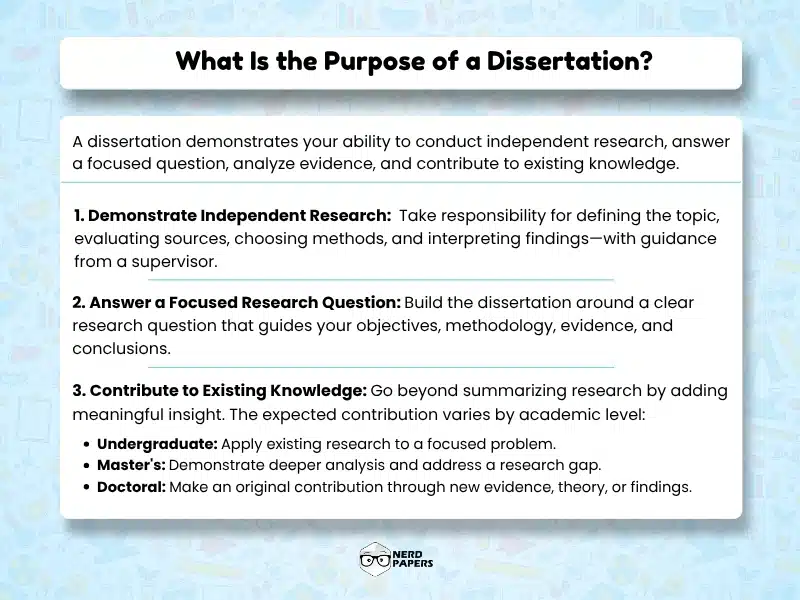
The purpose of a dissertation is to demonstrate that a student can investigate a defined research problem independently and produce conclusions supported by academic evidence. It brings together skills developed throughout a degree, including critical reading, research design, data analysis, academic argument, and scholarly writing.
Demonstrating Independent Research Ability
Independent research does not mean working without a supervisor. It means taking responsibility for the major research decisions, from defining the focus and evaluating scholarly sources to selecting suitable methods and interpreting the evidence. The dissertation supervisor provides guidance, but the student remains responsible for the direction and quality of the dissertation research.
Answering a Defined Research Question
A dissertation is built around a focused research question rather than a broad subject. That question shapes the research objectives and determines what methodology and evidence are needed. The analysis then produces findings that can be interpreted and used to reach a defensible answer to the original question.
Contributing to Existing Knowledge
A dissertation should also make a meaningful research contribution, although the expected level of originality varies. An undergraduate project may apply existing research to a focused problem, while a master’s dissertation usually requires greater analytical depth. A doctoral dissertation typically goes further by making an original contribution to knowledge, such as generating new evidence, addressing a research gap, or extending existing theory.
These purposes explain why an academic dissertation is more than a long assignment. Its defining features become even clearer when it is compared with other forms of academic work.
What Makes a Dissertation Different From Other Academic Assignments?
A dissertation differs from most academic assignments in its research depth, scope, and independence. Essays and coursework usually assess understanding of a defined subject, while a dissertation requires the student to develop and investigate a research problem through a sustained academic research project.
| Academic Work | Main Purpose | Research Depth | Methodology |
| Essay | Develop an evidence-based argument | Moderate | Usually no formal methodology |
| Research paper | Investigate a focused issue | Moderate to high | May use defined research methods |
| Coursework | Demonstrate subject knowledge | Varies | Depends on the assignment |
| Dissertation | Conduct sustained independent research | High | Usually explicit and justified |
A Dissertation Is Research-Driven
An academic dissertation is organized around a research question, methodology, evidence, and analysis. Rather than only discussing what existing sources say, the researcher uses them alongside an appropriate research design to investigate a specific problem and develop a supported academic argument.
Its Parts Work as One Research Project
The chapters of a dissertation are not separate assignments. The literature review establishes the research context, the methodology explains how the question is investigated, the findings present the resulting evidence, and the discussion interprets what that evidence means. Each part contributes to the same dissertation study.
It Requires Greater Research Independence
Students also take greater responsibility for defining the research focus, evaluating scholarly sources, making methodological choices, and interpreting findings. A supervisor can provide direction, but the key research decisions must remain academically justified.
These differences are reflected in the structure of a dissertation, where each section has a specific role in moving the research from its initial problem to its final conclusions.
What Does a Dissertation Include?
A dissertation is divided into sections that move the research from the initial problem to the final conclusions. The exact dissertation structure varies by discipline, university, and research design, but most dissertations contain several core components.
Title Page and Abstract
The title page identifies the study, while the abstract provides a concise overview of the research problem, methodology, key findings, and conclusions. Together, they establish what the dissertation research project examines and what it found.
Introduction
The dissertation introduction establishes the research context, defines the problem, and presents the research question or objectives. It also clarifies the scope and explains why the study is worth investigating.
Literature Review
The literature review examines and synthesizes relevant scholarly research. It establishes what is already known, identifies important theories and debates, and helps position the study in relation to a research gap or unresolved problem.
Research Methodology
The methodology explains the research design, methods, data collection, and analysis procedures used in the study. Its purpose is to show how the research question was investigated and why those methods were appropriate.
Results or Findings
This section presents the evidence produced by the research. Depending on the methodology, the findings may include statistical results, themes, patterns, observations, or other forms of research data.
Discussion
The discussion interprets those findings rather than simply repeating them. It connects the results to the research question, existing literature, and relevant theoretical or conceptual frameworks to explain what the evidence means.
Conclusion
The conclusion brings the dissertation study together by answering the research question, summarizing the main findings, explaining their significance, and acknowledging important limitations. Where appropriate, it may also identify recommendations or directions for future research.
References and Appendices
The references document the scholarly sources used throughout the dissertation, while appendices contain supporting material that is relevant to the research but too detailed for the main chapters.
Knowing the purpose of each section explains what a dissertation contains, but developing those sections into one coherent study requires a separate research and writing process. A detailed guide to the stages involved in developing a dissertation can cover that process from planning and research through drafting and revision.
Although these components provide a common framework, dissertations can take very different forms depending on the type of research being conducted.
What Are the Main Types of Dissertations?
Dissertations can take different forms depending on the research question, the type of evidence required, and the conventions of the academic discipline. The main distinction is between studies that analyze empirical data and those built primarily around existing scholarship, theory, or applied work.
Empirical Dissertations
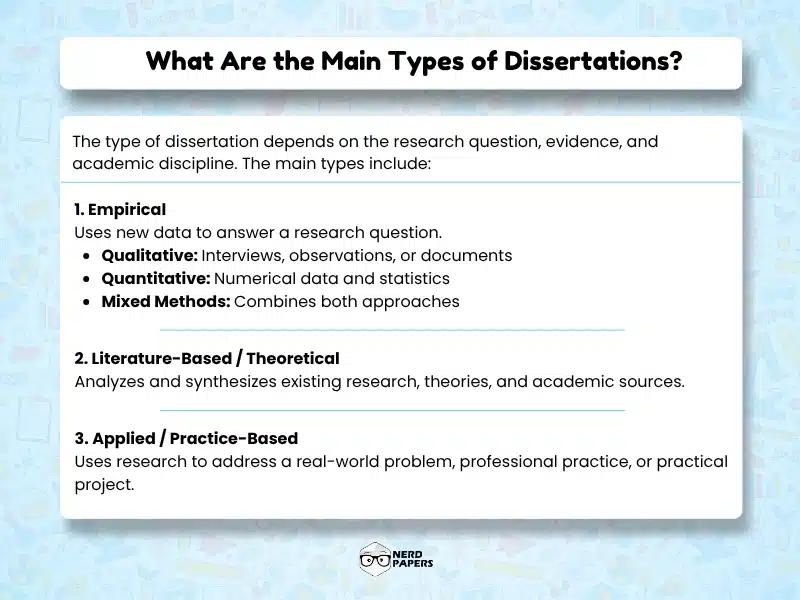
An empirical dissertation investigates a research question using observable or measurable data. Depending on the study, it may follow a qualitative, quantitative, or mixed-methods design.
- Qualitative dissertations work with non-numerical data from sources such as interviews, focus groups, observations, or documents to explore experiences, meanings, and patterns.
- Quantitative dissertations use numerical data, variables, statistical analysis, and sometimes hypothesis testing to examine relationships or differences.
- Mixed-methods dissertations combine qualitative and quantitative approaches when both forms of evidence are needed to address the research question.
Literature-Based or Theoretical Dissertations
A literature-based dissertation investigates a question through critical analysis and synthesis of existing scholarly research rather than collecting new participant data. A theoretical or conceptual dissertation may instead examine, develop, compare, or apply theories and concepts to produce a reasoned academic contribution.
Applied, Practice-Based, and Project-Based Dissertations
Some disciplines use dissertations built around a practical problem, professional setting, intervention, creative output, or applied project. The practical component does not replace academic research. It is normally supported by relevant literature, a clear methodological framework, critical analysis, and reflection on the findings or outcomes.
The type of dissertation research determines how evidence is collected and analyzed, but expectations also change with academic level. An undergraduate dissertation, for example, is not judged by the same research standards as a doctoral dissertation.
What Are the Main Types of Dissertations?
Dissertations can take different forms depending on the research question, the type of evidence required, and the conventions of the academic discipline. The main distinction is between studies that analyze empirical data and those built primarily around existing scholarship, theory, or applied work.
Empirical Dissertations
An empirical dissertation investigates a research question using observable or measurable data. Depending on the study, it may follow a qualitative, quantitative, or mixed-methods design.
- Qualitative dissertations work with non-numerical data from sources such as interviews, focus groups, observations, or documents to explore experiences, meanings, and patterns.
- Quantitative dissertations use numerical data, variables, statistical analysis, and sometimes hypothesis testing to examine relationships or differences.
- Mixed-methods dissertations combine qualitative and quantitative approaches when both forms of evidence are needed to address the research question.
Literature-Based or Theoretical Dissertations
A literature-based dissertation investigates a question through critical analysis and synthesis of existing scholarly research rather than collecting new participant data. A theoretical or conceptual dissertation may instead examine, develop, compare, or apply theories and concepts to produce a reasoned academic contribution.
Applied, Practice-Based, and Project-Based Dissertations
Some disciplines use dissertations built around a practical problem, professional setting, intervention, creative output, or applied project. The practical component does not replace academic research. It is normally supported by relevant literature, a clear methodological framework, critical analysis, and reflection on the findings or outcomes.
The type of dissertation research determines how evidence is collected and analyzed, but expectations also change with academic level. An undergraduate dissertation, for example, is not judged by the same research standards as a doctoral dissertation.
What Is a Dissertation at Undergraduate, Master’s, and Doctoral Level?
The dissertation meaning in university changes with the level of study. Although each dissertation involves independent academic research, the expected scope, analytical depth, methodological rigor, and contribution become more demanding at higher degree levels.
Undergraduate Dissertation
An undergraduate dissertation is usually a focused research project designed to demonstrate that a student can investigate an academic question independently. It typically requires engagement with scholarly literature, an appropriate research approach, critical analysis, and well-supported conclusions, but a major original contribution to the field is not normally expected.
Master’s Dissertation
A master’s dissertation involves more advanced postgraduate research. Students are generally expected to engage more critically with existing literature, justify their research methodology, conduct deeper analysis, and show how their findings relate to the wider field.
Doctoral Dissertation
A doctoral dissertation is a substantial and rigorous research study completed as part of a PhD or other doctoral degree. It requires extensive engagement with existing scholarship and, crucially, an original contribution to knowledge that can be examined and defended academically.
| Level | Main Expectation | Research Depth | Original Contribution |
| Undergraduate | Demonstrate research competence | Moderate | Usually limited |
| Master’s | Conduct advanced independent research | High | May be expected to some degree |
| Doctoral | Produce significant scholarly research | Very high | Normally required |
Exact dissertation expectations vary by university, discipline, and program. Regardless of academic level, however, a longer or more complex study is not automatically a stronger one. Dissertation quality depends on how effectively the research question, methodology, evidence, analysis, and conclusions work together.
What Is a Good Dissertation?
A good dissertation is a focused, well-researched, and methodologically sound study in which the research question, literature, methodology, evidence, analysis, and conclusions work together. Dissertation quality depends less on complexity or length and more on whether each research decision is justified and contributes to answering the central question.
A Clear and Focused Research Question
A strong dissertation begins with a research question that is specific, researchable, and appropriately scoped. It should address a meaningful research problem while remaining manageable within the available time, evidence, and academic requirements.
Critical Engagement With Existing Research
A well-researched dissertation does more than summarize scholarly sources. It compares findings, evaluates competing arguments, identifies patterns or disagreements, and shows how the current study fits within existing knowledge.
A Methodology That Fits the Research Question
The research method should follow from what the study needs to investigate. Whether the dissertation uses qualitative, quantitative, mixed, or literature-based research, the methodology should be appropriate, clearly justified, and applied consistently.
Credible Evidence and Rigorous Analysis
Evidence alone does not make a dissertation strong. The researcher must analyze it systematically, identify meaningful findings, and distinguish between what the evidence demonstrates and what can only be inferred from it.
A Coherent Academic Argument
A strong academic dissertation maintains a clear line of reasoning from the research problem through to the conclusion. Each chapter should contribute to the same investigation, with claims supported by relevant scholarly evidence or research findings.
Conclusions That Follow From the Evidence
The conclusions should answer the research question without making claims the findings cannot support. A rigorous dissertation also recognizes important limitations and explains how they affect the interpretation or wider application of its findings.
A Meaningful Research Contribution
What counts as a meaningful contribution depends on the degree level and discipline. It may involve generating new evidence, applying an existing theory in a new context, addressing a research gap, challenging an assumption, or producing a useful synthesis of existing research.
These characteristics of a good dissertation are also closely connected to how universities assess dissertation quality. Examiners look not only at the final conclusions, but at the quality and consistency of the research decisions that produced them.
How Is a Dissertation Assessed?
A dissertation is assessed against the academic standards set by the university, department, and degree program. There is no universal grading rubric, but dissertation assessment criteria commonly examine the quality of the research question, literature engagement, methodology, analysis, argument, conclusions, and overall research integrity.
Research Question and Objectives
Examiners consider whether the research problem is clearly defined and whether the question and objectives provide a focused direction for the study. An overly broad or poorly defined question can weaken the entire dissertation research project.
Literature and Subject Understanding
A strong dissertation demonstrates critical engagement with relevant scholarly literature. Assessment usually considers whether sources are credible, key debates are understood, and existing research is analyzed rather than simply summarized.
Methodological Rigor
The methodology should be appropriate for the research question and clearly justified. Examiners may assess the research design, data collection and analysis methods, methodological transparency, and consistency between the chosen methods and research objectives.
Analysis and Critical Thinking
High-quality dissertation research requires more than presenting information or data. Examiners look for analytical depth, interpretation of evidence, critical reasoning, and an ability to explain what the findings mean within the wider academic context.
Findings, Conclusions, and Contribution
The conclusions should follow logically from the evidence and address the original research question. The expected research contribution varies by degree level, but claims should remain proportionate to what the study actually demonstrates.
Coherence and Academic Presentation
Organization, academic writing, citation accuracy, and consistency also contribute to dissertation quality. A well-structured study should maintain a clear connection between its research problem, methodology, findings, discussion, and conclusions.
These criteria help explain what makes a good dissertation, but assessment is not determined by academic quality alone. Practical factors such as the appropriate scope and length of the research project also depend heavily on the degree, discipline, and university requirements.
How Long Is a Dissertation?
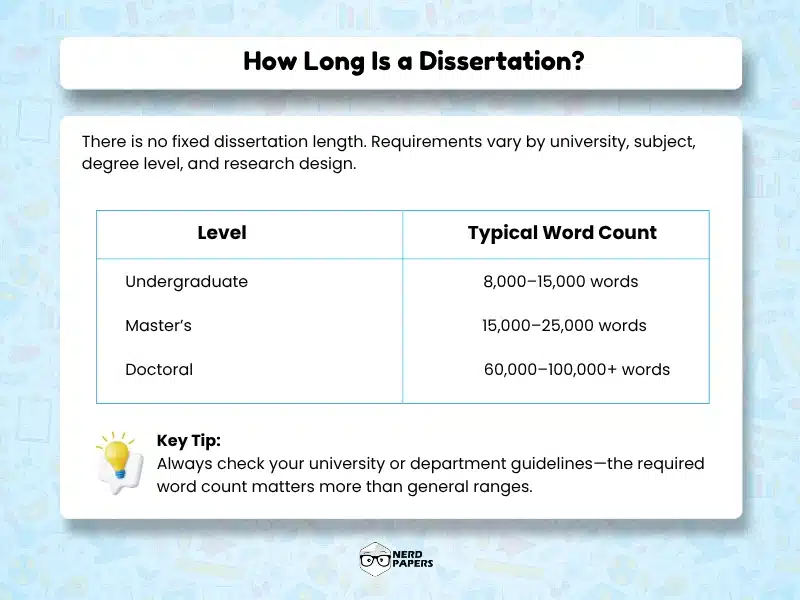
There is no universal dissertation length or word count, but dissertations commonly range from about 8,000 words at undergraduate level to 100,000 words or more for some doctoral projects. The exact requirement depends on the university, discipline, degree level, and research design, so students should always follow their program’s official guidelines.
Undergraduate Dissertation Length
An undergraduate dissertation commonly ranges from 8,000 to 15,000 words, or roughly 30–60 pages of main text. These projects are generally narrower in scope because their main purpose is to demonstrate the student’s ability to conduct focused independent research.
Master’s Dissertation Length
A master’s dissertation is often around 15,000 to 25,000 words, which may translate to approximately 60–100 pages. The greater length usually reflects deeper engagement with scholarly literature, more developed methodology, and a higher level of critical analysis.
Doctoral Dissertation Length
A doctoral dissertation commonly falls between 60,000 and 100,000 words, or approximately 200–300+ pages, although substantial variation exists across disciplines and universities. Doctoral research is typically more extensive because it must demonstrate rigorous scholarly investigation and an original contribution to knowledge.
| Academic Level | Typical Word Count | Approximate Page Count |
| Undergraduate | 8,000–15,000 words | 30–60 pages |
| Master’s | 15,000–25,000 words | 60–100 pages |
| Doctoral | 60,000–100,000+ words | 200–300+ pages |
These figures are general estimates rather than fixed academic standards. Page counts can vary considerably with formatting, tables, figures, references, appendices, and institutional requirements.
Does a Longer Dissertation Mean a Better Dissertation?
No. What makes a good dissertation is not the number of pages it contains but whether its scope is appropriate and its research is rigorous. A focused study with a clear research question, sufficient evidence, strong analysis, and justified conclusions is academically stronger than an unnecessarily long dissertation with weak or repetitive material.
Length is therefore partly a consequence of the project’s scope. That scope also affects the time required to complete the research, analysis, writing, and revision involved in a dissertation.
How Long Does a Dissertation Take?
There is no fixed dissertation timeline, but an undergraduate dissertation may take around 3–6 months, a master’s dissertation often takes 6–12 months, and a doctoral dissertation can take 3–5 years or longer as part of a PhD program. The actual timeframe depends on the research scope, methodology, access to data or participants, institutional requirements, and the amount of analysis involved.
A focused literature-based study may progress faster than an empirical project that requires participant recruitment, ethical approval, data collection, and detailed analysis. For this reason, two dissertations at the same academic level can still follow very different timelines.
A dissertation research project usually develops through several connected stages, including defining the research focus, reviewing scholarly literature, establishing the research design, collecting or examining evidence, analyzing findings, drafting the study, and revising it in response to feedback.
| Academic Level | Typical Timeframe |
| Undergraduate | 3–6 months |
| Master’s | 6–12 months |
| Doctoral | 3–5+ years |
These are general estimates rather than fixed deadlines. Research access, ethics procedures, methodological complexity, data analysis, supervisor feedback, and revision can all extend or shorten the process.
Before much of this research begins, universities commonly require students to establish what they intend to investigate and how they plan to do it. That proposed study is usually set out in a dissertation proposal, which serves a different purpose from the completed dissertation.
What Is the Difference Between a Dissertation Proposal and a Dissertation?
A dissertation proposal describes the research a student plans to conduct, while a dissertation presents and evaluates the research that has been completed. The proposal establishes whether the intended study is relevant, feasible, and methodologically appropriate before the full dissertation research project moves forward.
A proposal typically outlines the research problem, question or objectives, relevant academic context, proposed methodology, and intended scope. The completed dissertation goes further by presenting the actual research process, evidence or data, analysis, findings, discussion, and conclusions.
In simple terms, the proposal explains what will be investigated and how, whereas the dissertation explains what was investigated, what the research found, and what those findings mean.
Because the proposal must justify the study before the comprehensive research is carried out, its requirements differ from those of the final dissertation. Understanding the role and structure of a dissertation research proposal makes it clearer how the proposed research question, methodology, and scope establish the foundation for the larger study.
Once proposed research becomes an active study, however, methodology is not the only consideration. The research must also meet appropriate standards of ethics, integrity, and responsible academic practice.
What Role Do Research Ethics and Academic Integrity Play in a Dissertation?
Research ethics and academic integrity protect the credibility of a dissertation research study. The researcher must conduct the study responsibly, report methods and findings honestly, and acknowledge the ideas and evidence taken from other scholars.
Ethical Approval for Research
Dissertations involving human participants, sensitive information, or certain forms of data collection may require approval from an Institutional Review Board (IRB), Research Ethics Committee, or equivalent university body. Requirements vary by institution and research design, so not every dissertation follows the same approval process.
Informed Consent, Privacy, and Data Protection
Participant-based research may require informed consent and appropriate safeguards for confidentiality, anonymity, and personal data. These measures should align with the methodology and the ethical requirements governing the study.
Academic Integrity and Originality
A credible academic dissertation uses accurate citations, clear attribution, responsible paraphrasing, and honest reporting of evidence. Originality does not necessarily mean studying something no researcher has examined before. Depending on the degree level, original dissertation research may contribute through new evidence, a different context, a new application of theory, or a distinct interpretation of existing research.
Ethical and academically responsible research strengthens the credibility of the findings and conclusions. For some degrees, however, evaluation continues beyond the written dissertation through an oral examination or research defense.
What Happens After a Dissertation Is Submitted?
After submission, a dissertation is evaluated according to the university’s examination process. Depending on the degree and institution, this may involve examiner assessment, requested corrections or revisions, and an oral examination. The process determines whether the dissertation research meets the academic standards required for the degree.
What Is a Dissertation Defense or Viva?
A dissertation defense, also called a viva or viva voce in some academic systems, is an oral examination in which the researcher discusses and defends the study before examiners or a dissertation committee. Questions may focus on the research problem, methodology, findings, limitations, interpretations, and contribution to knowledge.
Not every dissertation requires an oral defense. It is particularly associated with doctoral research, while requirements for undergraduate and master’s dissertations vary by institution and program.
From the initial research question to final examination, a dissertation is therefore best understood as a complete academic research project, not simply a long paper. Its different elements work together to show how a research problem was investigated, what evidence was found, and what conclusions can reasonably be drawn from it.
Dissertation at a Glance
A dissertation brings several parts of academic research into one connected project. The table below summarizes the main points.
| Question | Short Answer |
| What is a dissertation? | An extended academic research project that investigates a focused question or problem using scholarly evidence and appropriate research methods. |
| What is the purpose of a dissertation? | To demonstrate independent research ability, critical analysis, and the ability to reach evidence-based conclusions. |
| What does a dissertation include? | Typically an introduction, literature review, methodology, findings or results, discussion, conclusion, and references. |
| What is a good dissertation? | A focused, coherent, and rigorous study with a clear research question, suitable methodology, credible evidence, critical analysis, and justified conclusions. |
| Who writes a dissertation? | Students may complete dissertations at undergraduate, master’s, or doctoral level, depending on their degree and institution. |
| Does a dissertation require original research? | It usually requires independent research, but the expected level of originality and contribution differs by academic level and discipline. |
| How long is a dissertation? | There is no universal length. Word count depends on the university, discipline, degree level, and research design. |
| Is a proposal the same as a dissertation? | No. A proposal sets out planned research, while the dissertation presents and evaluates the completed research. |
| What makes dissertation research credible? | Alignment between the research question, methodology, evidence, analysis, conclusions, and appropriate standards of research integrity. |
Together, these elements explain the dissertation definition more accurately than length or chapter count alone. A dissertation is ultimately a structured scholarly investigation in which each research decision contributes to answering a defined academic question.

Conclusion: What a Dissertation Ultimately Demonstrates
A dissertation is more than an extended piece of academic writing. It is a connected research project that moves from a defined problem and focused research question to an appropriate methodology, evidence, analysis, findings, and defensible conclusions. Its purpose is to demonstrate that the researcher can investigate an academic problem systematically and make informed research decisions.
Ultimately, what makes a good dissertation is not length or complexity, but alignment. The research question should guide the methodology, the evidence should support the analysis, and the conclusions should follow from the findings. When these elements work together, the dissertation becomes a coherent and academically credible contribution appropriate to the student’s degree level and field of study.
Frequently Asked Questions About Dissertations
1. What is a dissertation in simple terms?
A dissertation is a substantial academic research project in which a student investigates a specific question or problem. It involves examining relevant scholarship, using an appropriate research approach, analyzing evidence, and reaching conclusions supported by the study.
2. What is the main purpose of a dissertation?
The purpose of a dissertation is to demonstrate a student’s ability to conduct independent research, evaluate academic evidence, apply suitable research methods, think critically, and develop a defensible response to a defined research question.
3. What is a good dissertation?
A good dissertation has a focused research question, critical engagement with relevant literature, an appropriate methodology, credible evidence, rigorous analysis, and conclusions that follow logically from the findings. Coherence between these elements is central to overall dissertation quality.
4. Does a dissertation have to include original research?
A dissertation generally requires independent research, but original research can mean different things at different academic levels. It may involve collecting new evidence, examining an existing problem in a new context, applying a theory differently, or developing a distinct analysis. Doctoral dissertations normally require a clear original contribution to knowledge.
5. What are the main parts of a dissertation?
A typical dissertation structure includes an introduction, literature review, research methodology, results or findings, discussion, conclusion, and references. Abstracts and appendices are also common, although exact requirements vary by university and discipline.
6. How long is a dissertation?
There is no standard dissertation word count. Length depends on the degree level, discipline, research design, and university requirements. The appropriate scope and depth of the research matter more than reaching a general page or word count.
7. Is a dissertation harder than an essay?
A dissertation is generally more demanding because it involves a larger research scope, greater independence, a defined methodology, and deeper analysis. Unlike most essays, its chapters must work together as parts of one sustained dissertation research study.
8. Do all university students have to write a dissertation?
No. Dissertation requirements depend on the university, country, degree, and program. Some undergraduate and master’s programs require a dissertation, while others offer alternative research projects or coursework. Doctoral programs typically require substantial original research.